
Custom Coffee Truck, Trailer & Van Builder
A coffee truck is the most deceptively technical build in the food-service mobile space. The volume is lower than a taco line, the equipment count is smaller, but the tolerance is tighter. An espresso pulled at 9.3 bar instead of 9.0, with water at 189°F instead of 201°F, will cost you customers who notice. We build coffee trucks the way we’d build a fixed-location café, just with mobile-specific hardening around the water, power, and vibration.
Espresso machine selection
La Marzocco Linea PB (2 or 3 group). The industry benchmark. Saturated groupheads, PID temperature control, pre-infusion on every group. Requires 220V single-phase on a 2-group, 208V 3-phase on a 3-group. We install 60% of our coffee trucks with a Linea PB 2-group.
Slayer Single Group / 2-Group. Mechanical paddle flow control, preferred by specialty operators doing manual ratios and extended pre-infusion. More expensive and more temperamental in a mobile vibration environment, we add extra isolation mounts for the 3-way valves.
Victoria Arduino VA388 Black Eagle. Gravimetric (scale-integrated) with weight-based shot stopping. Best-in-class consistency for multi-barista operations. Most Black Eagle builds we do are for mobile operators serving a fixed corporate campus contract where shot consistency directly ties to contract renewal.
Nuova Simonelli Appia II (2-group). The workhorse at a lower price point. Not as refined as a Linea PB but bulletproof in high-volume events. We install these for operators doing the festival circuit.
Water: the single biggest quality variable
Water hardness and mineral content matter more on a coffee truck than in a fixed café because you cannot pick your source. You’ll fill from city water in Denver, well water at a ranch event, RV park water in Montana. We install a three-stage water treatment system on every coffee build:
- Stage 1: 5-micron sediment filter (catches silt, rust, pipe debris)
- Stage 2: Activated carbon filter (chlorine, chloramine removal, chloramine in particular will scald the group head seals)
- Stage 3: Reverse osmosis membrane with a remineralization cartridge. We remineralize back to 50-75 ppm calcium carbonate, the SCA recommended range for espresso.
We also install an in-line TDS meter so the barista can verify water chemistry before service. On well-water sites this catches contamination events before they damage the machine. La Marzocco group heads cost $2,400 per to replace; a $180 RO cartridge pays for itself every season.
Power: why coffee trucks need more electrical than you’d think
A 2-group La Marzocco Linea PB pulls 4,500W at steady-state boiler heat. Add a burr grinder (Mazzer Super Jolly at 450W), a refrigerated milk prep (250W), a POS system and card reader (80W), LED interior lighting (200W), and the total load climbs to 5,500W before you’ve made a single drink. During a milk-texturing peak, multiple baristas steaming at once, peak draw can hit 7,500W.
Our default coffee truck electrical spec: 50A/240V shore power + an onboard 8kW Cummins or Onan diesel or LP generator. We run a transfer switch so the generator kicks in automatically when shore power isn’t available. The generator is rubber-mounted with an upgraded muffler kit, noise complaints at farmers markets are almost always traced to the generator, not the ventilation fan.
For van conversions (Promaster, Sprinter, Kombi), we often spec a lithium battery bank (Battle Born or equivalent, 400-600Ah @ 12V) with a 3,000-4,000W pure sine inverter. That lets the barista run a 3-hour market without starting the generator. Past the 3-hour mark, the generator pays the batteries back.
Layout, hand-off window, and operator ergonomics
A coffee truck’s line is short, grinder, group, milk pitcher, hand-off. But it’s used 150-300 times a shift and any ergonomic friction compounds. Our standard layout:
- Grinder at the barista’s dominant hand. Counter height 34-36″.
- Espresso machine centered. Portafilter lock-in within a 12″ reach of the grinder dispense.
- Steam wand on the customer side of the machine so the barista faces the customer during the 30-second milk steam, best point in the interaction to upsell a pastry.
- Pitcher rinser left of the steam wand so the barista can one-handed rinse while texturing with the other.
- Knockbox under-counter, removable, directly below the grinder. The single worst mistake on a mobile coffee build is putting the knockbox somewhere that requires the barista to turn or walk, it adds 4-5 seconds to every ticket.
- Hand-off window at counter height, 16-20″ wide, with a lip to set cups down.
Real Coffee Food Truck builds from our shop
Frequently Asked Questions
Can I build a coffee truck on a VW Kombi / vintage van?
Promaster, Sprinter, or Transit?
What does a coffee truck cost?
Do I need a water tank or a pressurized hookup?
Can I run the espresso machine on battery power?
How long does a coffee truck build take?
Frequently Asked Questions
How much does a coffee or espresso trailer cost?
Coffee trailers start at $40,000 and trucks at $55,000. Espresso trailers are the most common and economical option.
How long does it take to build?
About six weeks.
Which espresso machines do you support?
La Marzocco, Slayer, Synesso, Nuova Simonelli and others. We size electrical and water for the machine you choose.
Do you handle fresh and grey water?
Yes, fresh-water and grey-water tanks plus filtration are standard on our coffee builds.
Can you build a coffee truck instead of a trailer?
Yes. Trucks work well for events and locations where towing is impractical.
Do you ship outside Colorado?
Yes.
Request a quote for your Coffee build
Tell us about your vision, cuisine, equipment wishlist, timeline, budget. We reply within one business day.
Ready to build your coffee food truck?
We build to your menu, your service window, and your jurisdiction. Talk to us about equipment selection, layout, and the specific regulations in your city.
Recent coffee truck builds we delivered
Real builds, real customers, real delivery dates.
Delivered · Jul 2026
10ft Sprinter Coffee Van Conversion Built for alMOKA Coffee in Chicago, Illinois
Read the build story →Delivered · Jun 2026
14ft Bagel Food Trailer Built for Yard Sale Bagels in Bozeman, Montana
Read the build story →Delivered · May 2026
14ft Shuttle Bus to Coffee Truck Conversion Built for Estes Park, Colorado
Read the build story →Delivered · Apr 2026
16ft Donut and Coffee Food Truck Built for Sedona, Arizona
Read the build story →Recent coffee and drinks builds

Five batteries charged on shore power and 110 volt equipment throughout.

A drinks truck built around water, ice and three power sources, with a second window that pays for itself.
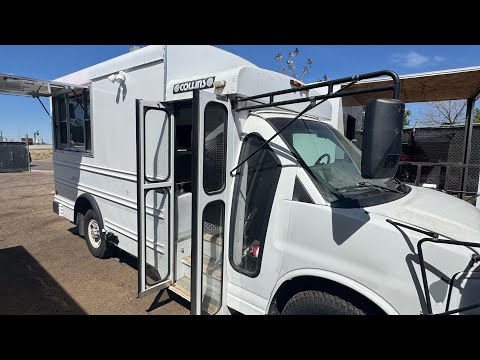
A 14ft Collins shuttle bus rebuilt as a mobile espresso bar for a mountain town.

A donut and coffee truck built for the Sedona tourist trade.
Every one of these started with a phone call and a menu. Call or text 719-722-2537.