
19 Years · 0 Failed Inspections · 1-Year Warranty On Every Build
Custom trucks from $55K · Custom trailers from $40K
Custom Food Truck Builder in Phoenix, Arizona
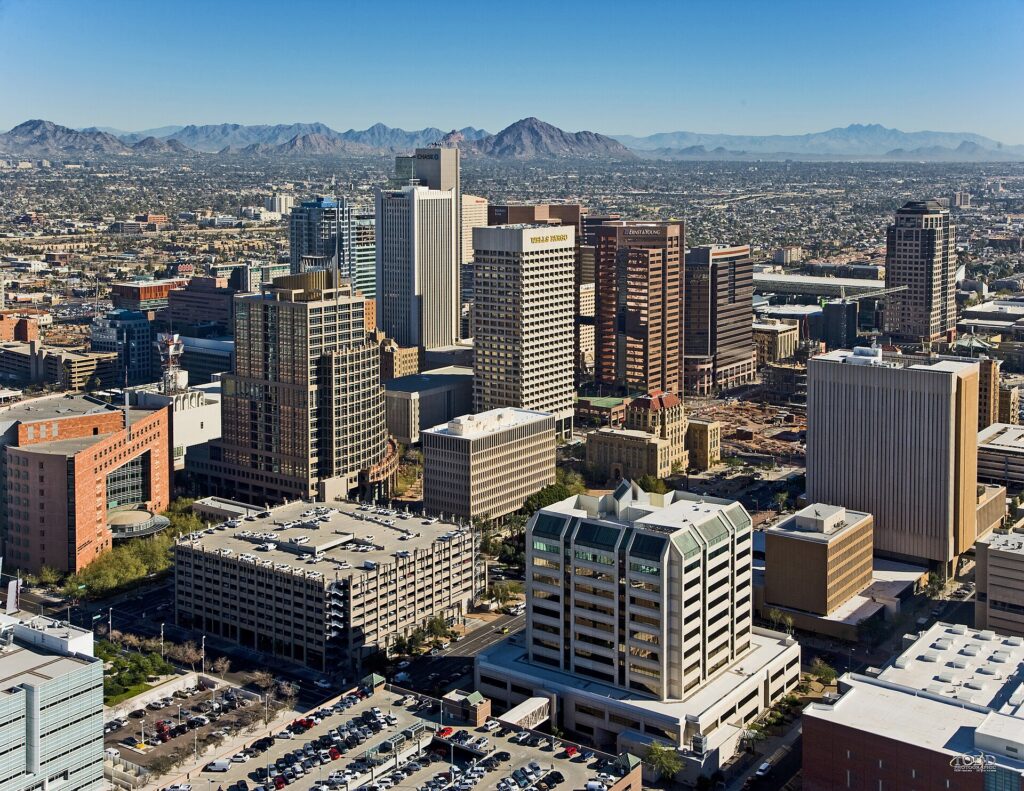
Phoenix is the 5th largest city in the United States and the heart of the Arizona food truck economy. From Roosevelt Row food truck Fridays to downtown sports-venue catering around Chase Field and Footprint Center, Zion Foodtrucks builds heavy-duty custom food trucks and trailers engineered for Valley of the Sun operators, units that hold temperature through 115°F summers, pass Maricopa County Environmental Services inspections on the first visit, and pull strong margins at Phoenix’s year-round festival calendar.
Get a Free Quote Now!

Experience, Quality, and Dedicated Support for Your Mobile Business
Why Phoenix Food Truck Operators Choose Zion Foodtrucks
Recent Arizona Builds
Real food trucks we have built and delivered to Arizona operators.
Sedona Donut and Coffee Truck
Sedona, AZRead the video transcript: Sedona Donut Coffee Truck
16-foot food truck for the red rocks tourist market.
Custom Arizona Food Truck Build
ArizonaRead the video transcript: AZ Build
Custom build delivered to an Arizona operator.
- Built for 115°F Valley of the Sun summers, oversized condensers, reflective roof coatings, and heavily insulated walls keep reach-ins at temp and compressors alive when ambient air on asphalt hits 140°+.
- Maricopa County Environmental Services (MCESD) plan-review packets included, we build to NSF/AZ mobile food unit code so your first inspection at the Phoenix Public Health office is a pass, not a punch list.
- Purpose-engineered for Phoenix revenue streams, Chase Field, Footprint Center, State Farm Stadium tailgates, Roosevelt Row, and corporate catering in the Loop 101 tech corridor.

Deep Local Knowledge of Phoenix's Food & Events Scene
- Festivals & venues we build for: Arizona State Fair, Devour Culinary Classic, McDowell Mountain Music Festival, Phoenix Pride, Roosevelt Row First Fridays, Cesar Chavez Plaza food truck events.
- Maricopa County + City of Phoenix permit guidance, TPT (Arizona Transaction Privilege Tax) registration, MCESD mobile food unit licensing, and fire-suppression sign-off timelines explained before you sign.
- After-sales support across the Valley, service visits from Surprise to Queen Creek, quick commissary referrals, and festival-readiness checkups before peak season.
The Phoenix market and where trucks actually work
Phoenix is the fifth largest city in the country and the anchor of a metro that can keep a food truck busy nearly every week of the year. The Valley of the Sun is really a chain of markets running together: downtown Phoenix and Roosevelt Row, Old Town Scottsdale, Tempe and the ASU corridor along Mill Avenue, and the fast-growing East Valley cities of Mesa, Chandler, Gilbert, and Queen Creek, out to Glendale and the West Valley. Each one has its own rhythm, and an operator who understands that can string together a full schedule instead of chasing the same Friday-night slot everyone else wants.
The events calendar is what sets Phoenix apart from most markets. First Fridays on Roosevelt Row pull big walking crowds downtown. Games and concerts around Chase Field and Footprint Center feed steady catering and curbside demand. Spring training brings the Cactus League and a wave of visitors across the East Valley every February and March. And winter is the busy season here, not summer: when much of the country is cold, Phoenix fills with snowbirds, resort guests, and outdoor festivals, and the weather is ideal for a truck. That flips the usual playbook, and it means a Phoenix unit earns most of its money in the months a northern truck would sit parked.
Private and corporate work rounds out the year. The office corridors in Tempe, Chandler, and North Scottsdale run weekday lunch programs, breweries and taprooms across the Valley book trucks to keep customers on site, and the wedding and event business runs strong through the mild months. There is real money in this market, and there is real competition too, so the truck you show up in matters before the food ever hits the window.
Building for extreme Valley heat
Nothing shapes a Phoenix build like the heat. Summer highs sit above 110 degrees for weeks at a time, the Valley sees more than a hundred days over 100 degrees in a typical year, and the monsoon from July into September piles dust, wind, and sudden humidity on top of the temperature. A truck built for a mild climate will fight its own refrigeration all summer, cook its crew, and trip breakers at the worst possible moment. We build for the Valley from the first drawing.
On a heat-hardened Zion build that means:
- Refrigeration and freezer capacity sized to hold safe temperatures in ambient heat, with condensing units and compressors chosen for high-temperature performance rather than the base spec.
- Heavier insulation in the walls, roof, and cold-side lines so the cold stays in and the equipment is not running flat out all day.
- Strong exhaust and make-up air so the cook line clears heat instead of trapping it, plus crew-cooling options so your people can work a full summer shift.
- Electrical and generator capacity sized for the real load, with air conditioning and refrigeration running together, so nothing browns out during a lunch rush.
- Sealed, dust-resistant construction and finishes that stand up to monsoon grit and hard sun without fading or corroding.
These are the details that decide whether a truck is a workhorse or a headache in July, and they are why Valley operators come to a builder who knows the climate instead of ordering a generic unit from out of state.
Maricopa County and City of Phoenix permitting, at a glance
Mobile food in the Valley is regulated first by the Maricopa County Environmental Services Department. A food truck operates under a county Mobile Food permit, and the county sorts units into Type I, Type II, and Type III based on how much cooking and food handling the menu involves. The more your menu does on board, the higher the classification and the more the build has to support it, which is exactly why the equipment plan and the permit class should be decided together, before anything is fabricated.
The county process generally involves submitting your application, your menu, a commissary or base-of-operations agreement where required, a toilet-use agreement, photos, and a route sheet, then receiving a permit card and plate that stays with the unit. On top of the county permit, the City of Phoenix has its own vending licenses, and vending on streets, sidewalks, and the public right-of-way, as well as on private property, carries its own city rules. Other Valley cities each add a layer of their own.
We are not your lawyer or your permit office, and rules and fees change, so confirm the current requirements with the county and your city before you commit. What we do is build the unit to meet Maricopa County health construction standards so it is ready to pass inspection on the first visit, which is the step that trips up operators who bought a truck that was never built to code.
What we build for Phoenix operators
Zion builds heavy-duty custom trucks and trailers to order. We start with your menu, your target events, and your budget, then design the equipment layout, the refrigeration, the cook line, the water and electrical systems, and the finish around how you actually plan to work. A truck fits operators who want to move between neighborhoods and events through the day; a concession trailer often makes more sense for a fixed brewery lot, a market stall, or a higher-volume kitchen where towing to the spot and setting up is the routine. We help you choose between them based on your menu and your calendar rather than pushing one or the other.
Everything is built to commercial standards with durable stainless construction, and every build carries our one-year warranty and the same record behind it: nineteen years of building and zero failed health inspections. We deliver finished units across the Phoenix metro, from downtown and Scottsdale out through the East and West Valley.
Guidance for first-time Phoenix owners
If this is your first truck, start with the menu and the specific events you want to work, because those two things drive every real decision about the build. Right-size the unit to that plan instead of buying the biggest truck you can; a tighter, well-designed layout is easier to run and cheaper to operate. Sort out your commissary early, since the county may require a base-of-operations agreement before it will permit you at all. Budget honestly for summer, when air conditioning and refrigeration push your power needs and your energy costs up. And build your calendar around the Valley seasons, leaning into the packed winter and spring months while planning night events, shaded venues, and indoor catering to keep revenue steady through the hottest stretch of the year. We walk first-time owners through all of this while we spec the build, so the truck you take delivery of matches the business you are actually trying to run.
Build your Phoenix truck
Tell us your menu, the events you want to work, and your timeline, and we will help you spec a unit that holds up to the Valley and is ready to pass inspection on day one.
FAQ
Frequently Asked Questions
Answering your questions about our food Truck manufacturing services.
Phoenix operators need a Maricopa County Environmental Services (MCESD) Mobile Food Unit permit, an Arizona TPT license, a City of Phoenix business license, and fire-suppression sign-off from Phoenix Fire. Zion Foodtrucks delivers every build with the MCESD plan-review packet pre-assembled so your first inspection at the Phoenix Public Health office on N 24th Street is pass-ready.
Yes. Every unit destined for the Valley leaves our shop with oversized condensers, reflective white roof coatings, thick closed-cell wall insulation, and commercial reach-ins rated well past desert ambient. We’ve had Phoenix operators run July lunch service on Central Avenue without a single compressor issue.
Absolutely. We’ve built units that work Chase Field tailgates, Footprint Center events, and the Cardinals’ Red Sea in Glendale. We spec high-volume fryers, dual reach-ins, and triple-basin sinks sized for 300+ covers per service.
Yes, we sequence heavy-duty builds around the fall State Fair and the February Devour Classic. Book early; our Phoenix-bound calendar fills fastest for Q3 delivery.
Yes. Valley tech corporate catering is one of our highest-margin customer segments. We build compact, pro-level trucks that fit campus drop lots and slide into tight Intel, Honeywell, and ASU loading zones.
Typical custom builds run 10 to 16 weeks depending on complexity. Phoenix operators targeting a Q4 State Fair or Super Bowl LVIII-level event should book 5 to 6 months out.
Find Us
Service Area
We deliver and service food trucks across Phoenix including Downtown, Roosevelt Row, Arcadia, Biltmore, Central Corridor, Sunnyslope, Ahwatukee, Desert Ridge, Deer Valley, and Laveen.