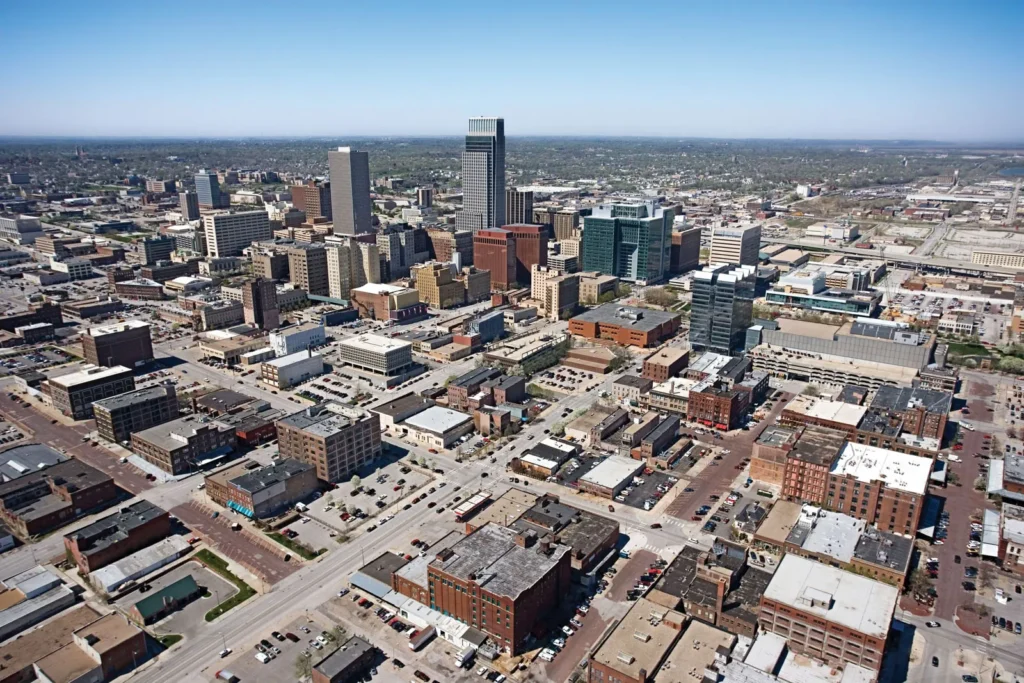
Omaha has the biggest food truck scene in Nebraska, with the Old Market, Aksarben Village, Midtown Crossing, the College World Series and a strong brewery circuit. This guide was rewritten in October 2026 from the county and city sources; an earlier version gave fee ranges we could not support.
The Douglas County health permit
Recent Nebraska Builds
Real rigs we have built and delivered to Nebraska operators.
Ram Promaster Coffee Van
Omaha, NE
Read the video transcript: Omaha Coffee Van
Welcome to Zion Foodtrucks. Today we have a relatively quick and uh simple project. Still pretty cool. Thought I'd show it off. Um this is a Ram ProMaster van which we converted to a coffee truck, coffee van. This one's going to Omaha, Nebraska. And uh it's uh it's simple in that we did not do the walls inside. Customer did not want us to. They would like to do that themselves. Um but in other respects it is complete. Um so it is a food truck. That is of course the window. That is a 6ft self-closing window. Right there is how you fill water. That is how you drain water. You pull the plunger. Water comes out. Um goes lights. This door we had to cancel and we had to do that because uh if you can see otherwise it would clash against the the window. the shore power connection capable of 220 watts which is what 220 amp volts my not watts uh that's what uh this whole truck needs let's go inside quite a simple um interior can see it's bare It's rare in that it it doesn't have walls. Um it does have electrical wiring which we did like we always do. It has 220 like I mentioned lights both interior and exterior plumbing system. Hand wash sink. Three compartment sink water heater and water pump. That is how you drain water and the fresh water and gray water tanks. As always, self-closing window. An espresso machine is going to be located here. And the espresso machine would require 220, which is what that is for. That is actually the removable shelf. um the outdoor shelf that is of course they would need additional equipment like grinders maybe a few other piece of equipment which is what that is for. You can see our wiring very nice and tidy and it's always as always in conduits. If you have any questions or if you would like um something like this, nothing is too small. Um, contact us through our website zanfuttros.com or through our uh phone number 72092653. Thank you. Have a nice day.
Cargo van conversion to a full mobile coffee operation.
16ft Mexican Food Truck
Omaha, NE
Read the video transcript: Omaha Mexican Food Truck
hello and welcome to Mile High food trucks today we have another beautiful food truck that we are about to ship this one is a Mexican theme this one's actually slightly different in that this is also a box truck well this used to be a box truck uh which we have converted into a food truck check out the cool graphics on the outside also in it is a 9500 W Predator generator which we Mount them typical to um many other food trucks that we have built in that it a generator box that is on the inside so that it doesn't get stolen we also build um custom extension cords so they can connect the generator to the truck or the truck to the wall these are of course made out of six cug wire custom cables another difference here is that this truck the customer requested that the um the the gas tank the propane tank be on the outside they want it to be replaceable so this one has a 100 lb tank similar to food trailers on the rear of the trailer it's of course also wrapped check out the cool graphics on the outside right here is the 5T um 5T service window with self closing door course of course that is we can lift pass the product and it will come down by itself to keep the box out LED lights on the inside and outside right there is where you fill the water so you open that and you put in a garden house to fill the water tanks for a tank singular in this case right there is how you drain the water similar to RVs so you take the cap off you pull the plunger and the water would fall down from the 40 lb uh gray water tank which is mounted in the bottom of the tra truck the truck has about 100,000 mil used to be a FedEx truck you can see the AC on the roof which is uh rbac of course and the 1650 CFM uh exhaust fan oh something I forgot to mention was this sh power Inlet you can connect to to your house or a commissary this way on the side of the 1650 CFM fan is a small uh grease catch pan so the grease doesn't run down the side of the truck let's go inside and see the interior of this beautiful food truck and to get to the inside is a RV door that we put in of course the much like most FedEx trucks the back of this truck was uh much like that uh it had a rollup door which of course we demolished and uh uh we framed it in and we added this 32 in wide um RV window RV door and the RV door also has a screen so you can actually just have the screen door on to give a little bit more ventilation now let's go see the inside of this beautiful food truck let's start in the front right there let me turn the AC off right there is the uh three compartment sink NSF approved obviously to comply with the regulations below that is the freshwater tank as that I mentioned earlier 30 Gall 8 Gall water heater electric hand wash sink with Splash GS the soap dispenser and the uh towel dispenser check out the plumbing on the bottom of this we of course make sure that that nothing leaks the water pump that is the service window the interior of it you lift this thing pass the product and it closes by itself this also has a refrigerator and a freezer of course all equipment are mounted to floor as well as to the walls with washes so they're not going anywhere when the truck is in transit right there is the uh the carbon monoxide and the propane uh sensor in case there is a propan or a carbon monoxide Le inside the truck the AC that I just shut off right there is the breaker panel just like all the other food trucks that we built every single piece of equipment has its own breaker so if the refrigerator was to fail it's not going to take out something else and all the wiring is in these conduits this way you can drill into any of the walls to hang like a bracket or a shelf or anything also the wires are not going to get damaged due to chafing that is a 36 in mega top sandwich prep it's got a lot of little trades for the toppings next to that is a propane um steam table next to that is a uh two burner stuff 48 in griddle this is a Mexican food truck of course uh Mexican food uses griddle extens siing the 8 foot um 7 foot in the skis I apologize uh Hood type one with fire separation andil as always these are the individual drops of course this comes certified and installed by uh certified hands tags everywhere more Outlets that's the interior of the generator box you can of course keep something on top of it if you like the floor is of course aluminum diamond plate all the walls are stainless steel that brings us to the end of the tour of this beautiful food truck if you have any questions would like a food truck for yourself um get in touch with us at uh mile highcustom food trucks.com or Zion food trucks.com thank you and have a nice day
Custom 16-foot Mexican food truck.
22ft Cameroonian BBQ Trailer
Lincoln, NE
Read the video transcript: Lincoln Cameroonian BBQ
hello and welcome to Mile High and Zion food trucks today we have this beautiful 22 ft barbecue trailer it's actually an African barbecue trailer that we're shipping out today let's check out its many features it's kind of uh noisy outside so we starting in on the inside here we have a 10 ft hood of course with fire suppression um two friers 40 lb each of them and a fairly large gr uh large range the range has six burners and a 24in griddle and two ovens that's just the box that the TV came in we'll show you the TV later this is a freezer an undercounter freezer worktop freezer so they can do their um cutting and other stuff here a table a service table that is that's the service vendor self closing of course as with every other trailer Inside the walls or truck inside the walls is 1 in of insulation 9/16 in of plywood and the cooking wall is stainless the other walls they are uh F FRP every single circuit is of course um separately isolated with individual Breakers lights for inside and outside that's the switch for the uh fan itself AC remote that's the AC with heat three compartment sink hand wash sink soap and towel dispensers all the plumbing is on the inside right here the gray water tank and the fresh water tank of course pump water heater so of course locks away little microwave over there that's the bottle for the fire separation system and uh twin refrigerators the customer wanted a double door um this this trailer is not tall enough for a double door refrigerator so we got them two separate um individual refrigerators the floor is aluminum diamond plate LED lights of course and uh the walls as I mentioned is FP here stainless steel on this side let's go outside and uh see the how the outside on the outside of this trailer of course is the beautiful wrap which is of course cameroonian uh themed on top is the big fan which is I think 1650 CFM um with the little drip tray catch tray on top so the grease doesn't run down the side of the the trailer the generator box which houses the actual generator inside generator is of course on slides up front is is the shore power Inlet the water inlet gray water drain right there and of course the two LP cases on this side is of course the service window and the menu display which is of course both of these are lockable and can be secured this is the the business end of the trailer which is of course a charcoal and that is inside a porch it has a door to access the kitchen of course there is a porch light as well as well as a an outdoor rated electrical box in case they wanted to connect something else here that brings us to the end of this tour a beautiful 22 ft African food truck if you have any questions or if you would like a a food truck build for yourself get in touch with us through www zood trucks.com or migh food trucks.com thank you and have a nice day
22-foot BBQ trailer built for high-volume Lincoln catering.
NDA contracts with the Douglas County Health Department for Omaha, so the county issues your health permit. Its listed annual mobile fees for the 2025 to 2026 cycle were $569 for a mobile food and drink vendor, $243 for drink only, $164 for retail, and $184 or $277 for ice cream pushcarts, with mobile permits running from 1 April to 31 March; check the current year’s amount when you apply. If you do not hold the commissary’s permit yourself, you file a commissary kitchen certification form, as the city’s OneBiz guide explains.
Building a food truck for Omaha? See what a fully-equipped, inspection-ready truck actually costs with our free build & cost calculator.
The city’s mobile food vendor permit, managed through Park Omaha, is $100 per vehicle, trailer or cart, with another $100 if you operate mainly in the Downtown Omaha business improvement district, renewed annually at the same cost. Vendors may not set up within 50 feet of a permanent food establishment without its written consent. Confirm operating hours and the Old Market rules with Park Omaha before you plan a downtown route.
Food handler training
Omaha changed its code in August 2025, and the Douglas County Health Department launched its food handler program in January 2026. Food establishment employees certify within 30 days of hire through the department’s program with UNL; it is $20 and valid two years, as the program FAQ sets out.
Fire
Omaha Fire inspects trucks that cook with grease or produce smoke. Expect the inspector to check a Type I hood with a UL 300 suppression system serviced every six months, Class K and ABC extinguishers, secured propane cylinders with leak tested lines and clear exits. The city does not publish a separate food truck fire fee, so ask when you book.
Taxes
Omaha’s combined sales tax is 7 percent, 5.5 percent state and 1.5 percent city, from the Department of Revenue table. The city’s 2.5 percent restaurant occupation tax applies to food trucks and mobile vendors, which the City Council extended to them in 2016. Trucks working the Avenue One district should check its separate rate.
In order
Line up a commissary in Douglas County. Apply to the Douglas County Health Department, pass the inspection and get the permit. Pass the Omaha Fire inspection. Get the city mobile food vendor permit and register for sales and occupation tax. Get your staff through food handler training within 30 days of hire.
Common Reasons Food Trucks Fail Omaha Inspections
We’ve consulted with over 30 food truck operators in Omaha. Here’s what causes failed inspections:
Improper propane installation or certification. The most common failure. Inspectors require visible certification labels and proof of annual servicing. If your propane system is missing documentation, the fire department fails you immediately.
Undersized hood system. Cooking trucks need 300+ CFM exhaust minimum. If your hood is too small for your cooking setup, airflow won’t meet code. This requires replacing your hood before opening.
Ansul system not charged or outdated. Many used trucks arrive with discharged Ansul systems or certifications years old. You must have current certification before you operate.
Commissary kitchen issues. Some operators try to use uncertified spaces or equipment. The health department will deny your application if the commissary isn’t licensed. Don’t assume any kitchen is acceptable.
Handwashing station not installed correctly. The sink must be separate from food prep and equipped with hot water. Some operators skimp here; the inspector always catches it.
Zoning violations. You get health approval but your location violates city zoning. One operator in South Omaha was told by planning department he couldn’t operate on a residential corner lot, even with health approval. Know your zoning before you sign a lease.
Missing grease trap or waste system. You must have an approved method for grease disposal and wastewater. You can’t just drain into a storm sewer or tank. Work with your commissary kitchen to establish this before inspection.
On video: trucks we built for Omaha
Read the video transcript: Omaha Mexican Food Truck
hello and welcome to Mile High food trucks today we have another beautiful food truck that we are about to ship this one is a Mexican theme this one's actually slightly different in that this is also a box truck well this used to be a box truck uh which we have converted into a food truck check out the cool graphics on the outside also in it is a 9500 W Predator generator which we Mount them typical to um many other food trucks that we have built in that it a generator box that is on the inside so that it doesn't get stolen we also build um custom extension cords so they can connect the generator to the truck or the truck to the wall these are of course made out of six cug wire custom cables another difference here is that this truck the customer requested that the um the the gas tank the propane tank be on the outside they want it to be replaceable so this one has a 100 lb tank similar to food trailers on the rear of the trailer it's of course also wrapped check out the cool graphics on the outside right here is the 5T um 5T service window with self closing door course of course that is we can lift pass the product and it will come down by itself to keep the box out LED lights on the inside and outside right there is where you fill the water so you open that and you put in a garden house to fill the water tanks for a tank singular in this case right there is how you drain the water similar to RVs so you take the cap off you pull the plunger and the water would fall down from the 40 lb uh gray water tank which is mounted in the bottom of the tra truck the truck has about 100,000 mil used to be a FedEx truck you can see the AC on the roof which is uh rbac of course and the 1650 CFM uh exhaust fan oh something I forgot to mention was this sh power Inlet you can connect to to your house or a commissary this way on the side of the 1650 CFM fan is a small uh grease catch pan so the grease doesn't run down the side of the truck let's go inside and see the interior of this beautiful food truck and to get to the inside is a RV door that we put in of course the much like most FedEx trucks the back of this truck was uh much like that uh it had a rollup door which of course we demolished and uh uh we framed it in and we added this 32 in wide um RV window RV door and the RV door also has a screen so you can actually just have the screen door on to give a little bit more ventilation now let's go see the inside of this beautiful food truck let's start in the front right there let me turn the AC off right there is the uh three compartment sink NSF approved obviously to comply with the regulations below that is the freshwater tank as that I mentioned earlier 30 Gall 8 Gall water heater electric hand wash sink with Splash GS the soap dispenser and the uh towel dispenser check out the plumbing on the bottom of this we of course make sure that that nothing leaks the water pump that is the service window the interior of it you lift this thing pass the product and it closes by itself this also has a refrigerator and a freezer of course all equipment are mounted to floor as well as to the walls with washes so they're not going anywhere when the truck is in transit right there is the uh the carbon monoxide and the propane uh sensor in case there is a propan or a carbon monoxide Le inside the truck the AC that I just shut off right there is the breaker panel just like all the other food trucks that we built every single piece of equipment has its own breaker so if the refrigerator was to fail it's not going to take out something else and all the wiring is in these conduits this way you can drill into any of the walls to hang like a bracket or a shelf or anything also the wires are not going to get damaged due to chafing that is a 36 in mega top sandwich prep it's got a lot of little trades for the toppings next to that is a propane um steam table next to that is a uh two burner stuff 48 in griddle this is a Mexican food truck of course uh Mexican food uses griddle extens siing the 8 foot um 7 foot in the skis I apologize uh Hood type one with fire separation andil as always these are the individual drops of course this comes certified and installed by uh certified hands tags everywhere more Outlets that's the interior of the generator box you can of course keep something on top of it if you like the floor is of course aluminum diamond plate all the walls are stainless steel that brings us to the end of the tour of this beautiful food truck if you have any questions would like a food truck for yourself um get in touch with us at uh mile highcustom food trucks.com or Zion food trucks.com thank you and have a nice day
Walkthrough of the 16ft Mexican food truck, Omaha.
Read the video transcript: Omaha Coffee Van
Welcome to Zion Foodtrucks. Today we have a relatively quick and uh simple project. Still pretty cool. Thought I'd show it off. Um this is a Ram ProMaster van which we converted to a coffee truck, coffee van. This one's going to Omaha, Nebraska. And uh it's uh it's simple in that we did not do the walls inside. Customer did not want us to. They would like to do that themselves. Um but in other respects it is complete. Um so it is a food truck. That is of course the window. That is a 6ft self-closing window. Right there is how you fill water. That is how you drain water. You pull the plunger. Water comes out. Um goes lights. This door we had to cancel and we had to do that because uh if you can see otherwise it would clash against the the window. the shore power connection capable of 220 watts which is what 220 amp volts my not watts uh that's what uh this whole truck needs let's go inside quite a simple um interior can see it's bare It's rare in that it it doesn't have walls. Um it does have electrical wiring which we did like we always do. It has 220 like I mentioned lights both interior and exterior plumbing system. Hand wash sink. Three compartment sink water heater and water pump. That is how you drain water and the fresh water and gray water tanks. As always, self-closing window. An espresso machine is going to be located here. And the espresso machine would require 220, which is what that is for. That is actually the removable shelf. um the outdoor shelf that is of course they would need additional equipment like grinders maybe a few other piece of equipment which is what that is for. You can see our wiring very nice and tidy and it's always as always in conduits. If you have any questions or if you would like um something like this, nothing is too small. Um, contact us through our website zanfuttros.com or through our uh phone number 72092653. Thank you. Have a nice day.
Walkthrough of the ram Promaster coffee van, Omaha.
Frequently asked questions
How much is a food truck permit in Omaha?
Douglas County Health Department listed $569 a year for a mobile food and drink vendor in the 2025 to 2026 cycle, running 1 April to 31 March, and the City of Omaha mobile food vendor permit is $100 per vehicle, with another $100 to operate mainly in the downtown business improvement district.
Do Omaha food truck workers need a food handler card?
Yes, since January 2026. Under an Omaha ordinance passed in August 2025, food establishment employees complete Douglas County Health Department food handler training within 30 days of hire. It costs $20 and lasts two years.
How close can a food truck set up to a restaurant in Omaha?
Not within 50 feet of a permanent food establishment without its written consent, under the city’s mobile food vendor permit rules.
What taxes does an Omaha food truck collect?
7 percent sales tax (5.5 percent state plus 1.5 percent city) and the city’s 2.5 percent restaurant occupation tax, which has applied to food trucks since 2016.
We build every truck to pass the plan review, the health inspection and the fire inspection on the first visit: a Type I hood with suppression installed by a licensed company, a three compartment sink and a hand sink with hot water, tanks sized for a full day, and propane in secured cylinders with a detector. Custom food trucks start at $55,000 and trailers at $40,000. Call or text 719-722-2537 with your menu and where you plan to sell.
Jacob Varghese Zion Foodtrucks 719-722-2537
Written & reviewed by the Zion Foodtrucks build team
Zion Foodtrucks builds custom food trucks, trailers, and concession trailers from our shop in Monument, Colorado and delivers them ready to pass inspection across the Mountain West. Owner Jacob Varghese and our team work with first-time owners every day, sourcing the vehicle and handling the full build so you do not have to. Questions about permits or your build? Call or text Jacob at 719-722-2537 or see our custom build services.
Free Food Truck Permit & Inspection Checklist
We put together a printable checklist covering every permit and inspection a mobile food business typically needs. Tell us where to send it and it is yours.
We design and build custom food trucks and trailers compliant with the regulations on this page. From a single phone call to keys-in-hand in 6 to 8 weeks for most builds.