Food truck permit requirements in Aurora Colorado - city aerial view

Food Truck Inspection Requirements in Aurora, CO: The Complete 2026 Guide

Running a Food Truck in Aurora: The regulatory setup

Aurora is the third-largest city in Colorado and one of the most diverse communities in the state. With a population that spans cultures and cuisines, it is no surprise that food trucks are thriving here – from Colfax Avenue corridors to the bustling Town Center at Aurora. But operating legally in Aurora requires navigating a distinct permitting process that differs from neighboring Denver in several key ways.

This guide walks you through every permit, inspection, and regulatory requirement for food truck operators in Aurora for 2026, including recent changes under Colorado House Bill 25-1295 and how Aurora’s municipal code affects where and when you can vend.

The Three Agencies You Will Work With

Getting your food truck permitted in Aurora means coordinating with three separate entities, each with its own application, timeline, and fee schedule.

1. City of Aurora Business Licensing Division: This is your starting point. Aurora requires a general business license for all mobile food vendors. The mobile food vendor license application costs $150 annually and must be renewed each January. You will also need to provide proof of a current commissary agreement and a copy of your vehicle registration.

2. Tri-County Health Department (TCHD): Aurora falls under Tri-County Health Department jurisdiction for food safety inspections. TCHD conducts plan reviews for new mobile food establishments ($250 for initial review) and performs unannounced inspections at least twice per year. Your truck must meet all Colorado Retail Food Establishment Rules (6 CCR 1010-2), with particular attention to handwashing stations, food temperature control, and waste disposal.

3. Aurora Fire Department: Fire Prevention Bureau: Fire inspections in Aurora are mandatory for any mobile food unit with cooking equipment. The fire inspection fee is $75, and you must schedule your inspection before your first day of operation. The Aurora Fire Department checks suppression systems, fire extinguisher placement and certification, propane line integrity, and clearance from combustible surfaces.

Fees and Costs for Aurora Food Truck Permits

Getting your food truck operational in Aurora involves several fees. The City of Aurora business license runs approximately $75 to $150 annually depending on your revenue bracket. Tri-County Health Department charges around $350 for your initial food establishment plan review, plus an annual inspection fee of roughly $280. Fire prevention permits add another $100 to $175 to your costs.

Factor in additional expenses like your commissary agreement (many Aurora commissaries charge $400 to $800 per month), liability insurance ($1 million minimum), and vehicle-specific costs such as propane system certification. Budget at least $2,500 to $4,000 in upfront licensing and permit fees before you start serving your first customer.

Fire Safety Standards for Aurora Food Trucks

The Aurora Fire Prevention Bureau takes fire safety seriously, especially with mobile food units operating propane-fueled cooking equipment in high-traffic areas. Every food truck must carry a Class K fire extinguisher rated for commercial kitchen grease fires, along with a standard ABC extinguisher. Your suppression hood system needs to be inspected and tagged by a certified technician every six months.

Propane tanks must be mounted externally or in a ventilated compartment that meets NFPA 58 standards. Aurora inspectors will check that your gas lines have emergency shut-off valves accessible from outside the truck. Electrical panels need proper grounding, and all wiring should be rated for mobile commercial use. Check out this 18-foot French cuisine food truck build that demonstrates proper fire safety setup:

Read the video transcript: Fire Suppression / Denver French Truck
Hello and welcome design food trucks. Today we have another exciting project uh leading us. This one is of course going to be here in Denver and it's going to make um gourmet sandwiches. It is 18 ft long and it has a few tricks up its sleeve. Let's look outside and see its uh exterior and then go inside. goes on the outside. What catches your eye would be the the French themed um wrap on the outside. Very beautiful if I may say so. Um very tasteful. Ties all the sandwich theme together. Um that of course is the awning for the 5-ft window. Self-closing obviously as is required by code. The two exterior lights. You can also see the air conditioner on top. The air conditioner also has a heat pump. That is how you would fill water into the fresh water tank. That is how you drain water from the gray water tank. On the back you would see the RV door as we call it. Um basically the code does not allow the the kind of um roll uh the rollup shutter the rollup door that is not up to code which is why we have to do this. I apologize for the road noise. The truck is parked for delivery. So um that is how you would drain the black water tank. This truck has a bathroom inside. So that's how you would train it. Of course that's the shore power connection the generator box of course which is as you can see lockable. It opens up and uh exposes the generator. That obviously is how the that is how the um that's actually where the um propane tank is. We call them underbelly tanks. you don't like them hanging out in the back of the truck. Um, it's a a fire risk in case if it's a rear ended or whatever. Now, let's go inside and see its many features. This truck, as with others that we build, has two doors, one in the back, one in the front. Code requires that any space a human occupies um must have a ingress and an ingress. This is the ingress, of course. Uh, right in front is the refrigerator. And right here is a range. And the range has a griddle and two burners. And the oven, of course, which is why it's a range. Um, the hood, as you can see, slightly oversized. This is because we believe that this customer might add more equipment as they go, you know, as they go about their business. the menu might change. Um maybe they will want soups or something else. Um which is why we left a little bit of space here and a larger hood. Talking about sandwiches, that's what we're going to be making the sandwiches on. This is a sandwich prep table, a refrigerated sandwich prep table. A freezer right there. The freezer is actually resting on a generator box. So you saw that door on the outside. Um, this is the generator box for it. Right there is a little freshwater tank and uh what it is for um is the toilet. This um truck has a restroom inside for the customer's personal use. Not really open to the public, but it is there. Now, you cannot have um obviously the other plumbing is on this side. Um so you cannot have these uh connecting together. What I mean is so the bathroom the water from the bathroom cannot at any point interact with the water um for the you know hand washing or or bear washing which is why it has completely different systems, different setups. So freshwater tank for the bathroom. There's a little water heater behind it. Of course it has its own water pump. And right there is the bathroom toilet, hand wash sink. Of course, hand wash sink also has hot water. This is the the pull tab for the uh fire extinguisher. On this side you would see a larger water heater and this is required because um of the area where this truck is going to be operating in. Food trucks as you know are regulated by um by county code at least for now. The wiring you would see just like with all our trucks um every piece of equipment has its own breaker. They're all home run so to speak. water heater, mop sink, hand wash sink, three compartment sink, and the um the service window. The service window as always is self-closing. So, you lift up, pass your product, and it closes by itself. The controller for the air conditioner, which is right here. lights. Of course, this truck has an all stainless construction and uh inside the walls is 1 in of insulation, 9/16 in of plywood. The floor is aluminum diamond plate and uh addition of the insulation makes it a very comfortable place to work in. If you have any questions or if you would like a food truck like this uh built for yourself, please do contact us through our website zfotrs.com or our phone number 7209-2653. Thank you. Have a nice day.

Health Department Inspection Breakdown

Tri-County Health Department conducts both scheduled and surprise inspections of Aurora food trucks. Inspectors evaluate your operation across several critical areas: food temperature control (cold items below 41F, hot items above 135F), handwashing stations with running hot water, proper food storage and cross-contamination prevention, and employee hygiene practices.

Your truck must have a three-compartment sink for washing, rinsing, and sanitizing equipment. Wastewater must be contained in a holding tank at least 15% larger than your fresh water supply. Inspectors also verify that all food contact surfaces are commercial-grade stainless steel or equivalent NSF-certified materials. Keep your most recent inspection report posted visibly inside the serving window.

Commissary Kitchen Requirements

Aurora mandates that every food truck operator maintain a commissary agreement with a licensed commercial kitchen. This is where you handle food prep that cannot safely be done inside the truck, store perishable inventory overnight, dispose of wastewater, and restock fresh water tanks. Your commissary must be within a reasonable distance of your operating area.

Several commissary kitchens serve the Aurora area, including facilities in the nearby Denver metro region. Make sure your agreement specifically states that the commissary is available during your operational hours and that it provides adequate cold and dry storage space. Health inspectors may visit your commissary to verify compliance.

Zoning and Location Rules in Aurora

Aurora has specific zoning ordinances that dictate where food trucks can and cannot park. You are generally permitted to operate in commercial and mixed-use zones, but residential neighborhoods have stricter limitations. Food trucks must maintain a minimum distance of 200 feet from brick-and-mortar restaurants unless you have written consent from the restaurant owner.

Public parks and city-owned properties require a special event permit or a parks department vending agreement. Many Aurora food truck operators find success at office parks, brewery patios, and community events. Always confirm that your chosen location has the proper zoning classification before setting up, as violations can result in fines starting at $250.

Colorado House Bill 25-1295: What It Means for Aurora Vendors

Effective January 1, 2026, Colorado House Bill 25-1295 introduced statewide food truck license reciprocity. If you already hold a valid mobile food vendor license from another Colorado municipality, Aurora must honor that license without requiring you to duplicate the entire permitting process. This is a major win for operators who serve multiple cities along the Front Range.

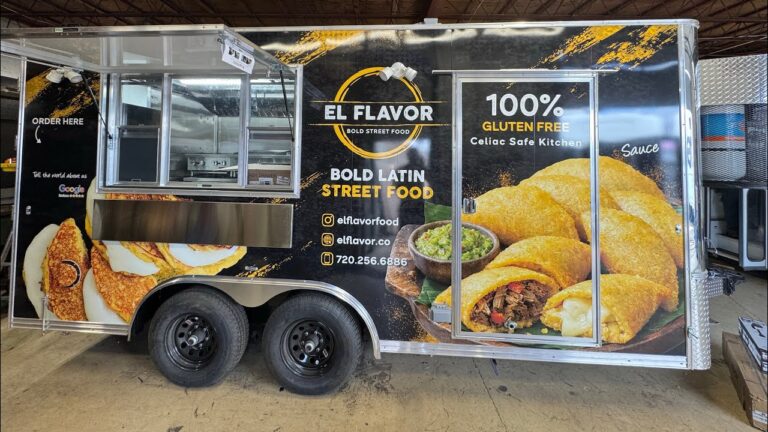
That said, you still need to register with the City of Aurora and comply with local zoning ordinances, fire codes, and any location-specific requirements. The reciprocity covers your health department credentials and business licensing, streamlining what used to be a redundant and expensive process. Take a look at this compact empanada food truck build designed for multi-city operations:

Step-by-Step: Getting Your Aurora Food Truck Licensed

Here is a practical walkthrough to get you from concept to legally serving food in Aurora. First, secure your commissary agreement with a licensed commercial kitchen. Next, submit your food truck plans to Tri-County Health Department for review, which includes your equipment layout, plumbing schematic, and menu. While the health review is processing, apply for your City of Aurora business license and sales tax license through the city clerk.

Once Tri-County approves your plans, schedule your initial health inspection. Simultaneously, contact the Aurora Fire Prevention Bureau to arrange your fire safety inspection. After passing both inspections, obtain your certificate of occupancy for the mobile unit. Register with the Colorado Department of Revenue for state sales tax, and secure your general liability insurance policy. The entire process typically takes six to ten weeks if you stay on top of each step.

Common Inspection Failures to Avoid

After working with hundreds of food truck owners across Colorado, we have seen the same mistakes derail Aurora inspections repeatedly. The most frequent failure is inadequate hot water supply at handwashing stations. Inspectors test the temperature on the spot, and anything below 100F is an automatic fail. Another common issue is missing or expired fire extinguisher tags, which the fire prevention bureau checks every time.

Improper food storage temperatures account for roughly 30% of health inspection failures in Aurora. Invest in a reliable digital thermometer and log your temperatures twice daily. Other frequent problems include gaps in the floor-to-wall seal that allow pests, missing sneeze guards at the serving window, and failure to maintain a current food handler certification for all employees working the truck.

Related Colorado Food Truck Guides

Planning to operate beyond Aurora? Colorado’s new HB 25-1295 reciprocal licensing law makes it easier than ever to expand your food truck business across the state. Check out our complete guide to starting a food truck in Colorado for everything you need to know about launching and growing your mobile food business.

Explore inspection requirements in nearby cities:

Frequently Asked Questions About Aurora Food Truck Permits

How much does a food truck permit cost in Aurora?

First-year costs for a food truck permit in Aurora typically range from $800 to $1,600. This includes the Tri-County Health Department mobile food license, Aurora business license, fire inspection fees, and food handler certifications. Aurora’s costs are generally lower than neighboring Denver.

How long does the Aurora food truck licensing process take?

Most applicants can complete the Aurora food truck licensing process within 3 to 5 weeks with complete documentation. The Tri-County Health Department handles health permits while Aurora Fire Rescue conducts fire safety inspections. Having your commissary agreement, insurance, and food handler cards ready before applying helps avoid delays.

Do I need a commissary kitchen to operate in Aurora?

Yes. Tri-County Health Department requires all mobile food vendors operating in Aurora to maintain a commissary agreement with a licensed commercial kitchen. This is where you must store food, clean equipment, and dispose of wastewater. Your commissary must be inspected and approved before your permit is issued.

What inspections are required for food trucks in Aurora?

Aurora food trucks must pass a health inspection from the Tri-County Health Department covering food handling, storage temperatures, water supply, and sanitation. You also need a fire safety inspection from Aurora Fire Rescue checking your propane system, fire suppression equipment, ventilation, and electrical connections.

Can I operate my Aurora food truck in other Colorado cities?

Yes. Under Colorado HB 25-1295, effective January 1, 2026, Aurora-licensed food trucks can apply for reciprocal licenses in any other Colorado city. Since Aurora borders Denver, this is especially useful for operators who want to serve both cities without going through a completely separate licensing process.

Aurora Food Truck Official Resources & Contact Information

Food truck health inspections in Aurora are managed by the Tri-County Health Department (TCHD), which serves Adams, Arapahoe, and Douglas counties. TCHD has a dedicated page for food truck and push cart regulations at tchd.org/445/Food-Trucks-Push-Carts. Their Environmental Health staff can answer questions about plan reviews, inspection scheduling, and mobile food vendor permit applications at (303) 220-9200.

The City of Aurora provides a detailed Mobile Food Vendor Toolkit available through their business licensing office. This toolkit includes step-by-step instructions for obtaining all required permits, a checklist of equipment standards, and a guide to approved vending locations. You can request the toolkit through the city’s business licensing division at (303) 739-7057 or visit auroragov.org and search for “mobile food vendor” to access the PDF guide for opening a mobile food business in Aurora.

Aurora spans three different counties (Adams, Arapahoe, and Douglas), which can create unique regulatory challenges for food truck operators. Depending on where you plan to vend within Aurora city limits, you may need to coordinate with different county agencies for certain permits. The city’s business licensing team can help you determine which county jurisdiction applies to your preferred vending location and connect you with the appropriate health department contacts.

Get Your Food Truck Inspection-Ready

Zion Foodtrucks specializes in building custom food trucks that pass Aurora inspections the first time. Every truck we build is designed with Tri-County Health Department standards, Aurora Fire Prevention Bureau codes, and Colorado state regulations in mind. From the plumbing layout to the fire suppression system, we handle the details so you can focus on your menu.

Whether you need a brand-new custom build or want to retrofit an existing vehicle to meet Aurora requirements, our team is ready to help. Call us at 719-722-2537 for a free consultation, or visit zionfoodtrucks.com to explore our builds and get started on your Aurora food truck journey.

Key Contacts for Aurora Food Truck Licensing

  • City of Aurora Business Licensing – 15151 E Alameda Pkwy, Aurora, CO 80012 – (303) 739-7000
  • Tri-County Health Department – 15400 E 14th Pl, Aurora, CO 80011 – (303) 220-9200
  • Aurora Fire Prevention Bureau – 15151 E Alameda Pkwy, Aurora, CO 80012 – (303) 739-7510
  • Colorado Department of Revenuetax.colorado.gov
  • Zion Foodtruckszionfoodtrucks.com – (720) 209-2653

Need Food Truck Services in Aurora?

Zion Foodtrucks provides professional food truck services in the Aurora area:

Call 719-722-2537 for a free quote.

Ready to build your truck?

We design and build custom food trucks and trailers compliant with the regulations on this page. From a single phone call to keys-in-hand in 6 to 8 weeks for most builds.

Built in Woodland Park, Colorado. Delivered to operators in CO, AZ, NE, MT, and WY.

Leave a Comment

Your email address will not be published. Required fields are marked *

Custom food truck builds delivered to: Colorado · Arizona · Nebraska · Montana · Wyoming