Custom Food Truck Builders in Colorado

Woodland Park, Colorado · Around 500 builds delivered

Custom food trucks from $55,000 · Custom food trailers from $40,000 · About six weeks of build time

Request a quote Call or text 719-722-2537

Zion Foodtrucks builds custom food trucks from the frame up in Woodland Park, Colorado. Around 500 food trucks, food trailers, bus conversions and van conversions have left the shop, most of them for first time owners across the Mountain West, and we deliver anywhere in the country. Custom food trucks start at $55,000; a typical 16ft truck comes in around $72,000 and a 22ft truck with a full equipment package around $110,000.

This page explains what a custom build from us actually includes, how the process runs, what it costs and how long it takes. If you would rather talk it through, call or text 719-722-2537 and we will go through your menu before anything gets drawn.

What custom means here

A custom food truck is one where the kitchen is laid out around the menu, not the other way round. A taco truck needs a griddle, a fryer and cold rails at arm’s reach. A donut trailer needs a proofing cabinet and three times the usual hot water. A jerk chicken truck needs a charcoal smoker that cannot live inside the kitchen at all. We start every build with a conversation about what you cook, how many you serve in an hour, how many people work the line and where the truck will park, and the layout follows from that.

Every truck we build gets the same bones. The cook wall is stainless steel and the remaining walls and ceiling are FRP, a food safe panel that wipes clean. The floor is aluminum diamond plate. Behind the walls is plywood and insulation; for trucks going somewhere cold we fit a heavier wall with thicker insulation and plywood backing. The cook line sits under a Type I exhaust hood with a wet chemical fire suppression system installed by a licensed fire protection company, with a Class K and an ABC extinguisher on board. Water is a fresh tank and a larger waste tank mounted under the truck, a water heater and a pump, feeding a three compartment sink and a separate hand sink. Power is a 100 or 125 amp panel with every breaker labelled and the wiring in conduit, fed by a generator sized for everything on the truck running at once, usually a Westinghouse or Cummins unit in a box. The service window is a five foot concession window with an awning door, self closing doors and a bug screen. Lighting is LED inside and out.

On top of that come the choices: the length, the equipment package, a second window, air conditioning with heat, a TV menu box, a wrap, shore power, batteries instead of a generator, a restroom for remote sites, or a porch for live fire. We have built all of those and the build videos show them.

Trucks, buses and vans

Most of our trucks start as a step van, between 14 and 22 feet of box. We also convert box trucks, shuttle and school buses, Ford Transits and Sprinters, and we build on vehicles customers already own. You do not need to find the vehicle yourself. For most builds we source it, which means you do not need a year, make, model or mileage to get a quote; you need a menu and a city.

If you do own something already, send photos. We built a Fort Collins açaí truck on a customer’s own Transit box truck and a taco truck from a used E350 box truck, and we will tell you straight if a vehicle is not worth the money.

How a build runs

The call

You tell us the menu, the volume you expect on a busy day, your crew size and where you plan to work. We tell you what length and what equipment that needs, and whether a truck or a trailer suits you better.

The drawing and the quote

We draw the layout, list the equipment with model numbers, size the generator and the tanks, and quote a firm price. You can also sketch your own layout first with our free kitchen layout planner. The drawing stage is where to spend an extra week, because once the walls are on nothing moves.

The build

About six weeks on our floor. We photograph every stage, which matters later because your health department wants to see what is behind the walls.

Handover

We test every burner, outlet and fixture, pressure test the gas, walk you through every system, and send you off with the spec sheet and photos your inspector will ask for. Most trucks are delivered 8 to 12 weeks after design approval.

What it costs

Custom food trucks start at $55,000 and custom food trailers start at $40,000. A typical 16ft truck comes in around $72,000 and a 22ft around $110,000. The cost guide breaks that down line by line and the cost calculator gives a planning range from your specs. If you own the vehicle and buy the equipment yourself, you pay us for the systems and the labour only, which is a fraction of a full build. Financing is available through lenders who know food trucks.

Built for the Mountain West

Our shop sits at 8,500 feet. Generators lose output with altitude, gas appliances need setting up for elevation, and water systems freeze. Every truck we build has those three things handled, which is why trucks bought in Texas or California so often arrive at our repair shop needing work before they can pass here. The cold weather page covers what changes for a truck that works through a Colorado or Wyoming winter.

We deliver across Colorado from Denver and Boulder to Grand Junction, across Wyoming through our sister shop Mile High Foodtrucks in Denver, and to Montana, Nebraska, the Dakotas, Kansas, Utah, Arizona, Nevada and beyond. The service area pages have the licensing detail for each state and city we work in.

After the build

We service what we build and what others built. The annual LP gas pressure test is $350, the fire suppression inspection is $300, and hood cleaning is quoted by hood size. Repairs on trucks from any builder are handled at the Woodland Park shop.

Frequently asked questions

How much does a custom food truck cost?

Custom food trucks start at $55,000. A typical 16ft truck comes in around $72,000 and a 22ft truck with a full equipment package around $110,000. The number moves with the length, the cook line, the generator and the finish, and we quote every build from your menu rather than from a price list.

How long does it take to build a food truck?

About six weeks of build time, and most trucks are delivered 8 to 12 weeks after the design is approved. The drawing stage is where the time is well spent, because the layout cannot be changed once the walls are on.

Do I need to find my own truck?

No. We source the vehicle for most builds, so you do not need to know a year, make, model or mileage before you call. If you already own a step van, a box truck, a bus or a van, send photos and we will tell you whether it is worth building on and quote the systems alone.

Will the truck pass inspection in my state?

Every build leaves with a Type I hood and a wet chemical suppression system installed by a licensed company, a three compartment sink and a hand sink with hot water, fresh and waste tanks sized to the rules, labelled breakers and a tested propane system. We build to the strictest code we work under and have delivered to Colorado, Wyoming, Montana, Nebraska, the Dakotas, Kansas, Utah, Arizona, Nevada, California and Illinois. Your health department and fire authority still inspect the truck, and we document every system so that inspection is a check rather than a negotiation.

Can you build a truck for high altitude and cold weather?

That is where we live. Our shop is at 8,500 feet in Woodland Park, Colorado, so every generator is sized with altitude in mind, gas appliances are set up for elevation, and for trucks headed somewhere with a real winter we fit a heavier wall with thicker insulation and plywood, blankets on the tanks and a larger water heater. Ask for it; it does not add much.

What is the difference between a food truck and a food trailer?

A truck drives itself and parks in a single space, which suits daily routes, catering and cities whose rules favour trucks. A trailer costs less, carries more kitchen for the money, and can be dropped at a brewery or a festival and left. Trucks start at $55,000 and trailers at $40,000, and we build both, so the honest answer depends on how you plan to work.

Do you offer financing?

We work with equipment lenders who finance food truck builds, and the financing page explains the usual terms and what they ask for. We also build for customers paying in stages, with the deposit covering the chassis and the balance due at handover.

Ready to start? Call or text 719-722-2537, or send us your menu through the contact page and we will come back with a layout and a price.

Recent food truck deliveries
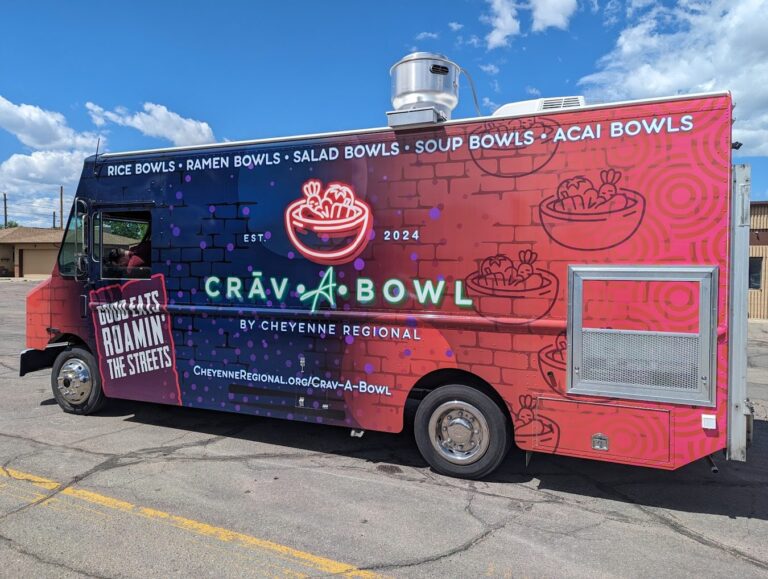
16ft hospital food truck, Cheyenne

Built for Cheyenne Regional Medical Center around a combi oven and a bowl menu.

16ft taco truck from a box truck, Aurora

A 2019 Ford E350 box truck turned into a sealed taco kitchen with its own framing and an RV door.

14ft boba tea truck, Fort Collins

A drinks truck built around water, ice and three power sources, with a second window that pays for itself.
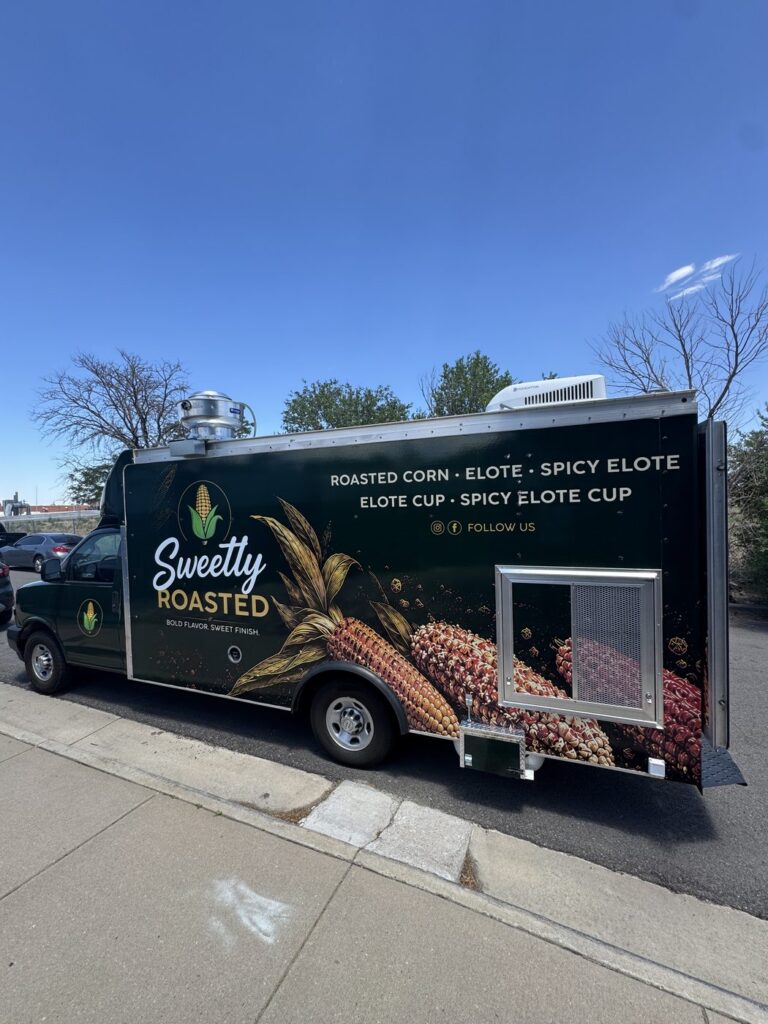
14ft roasted corn truck, Lakewood

Built without a generator on purpose: the truck runs on shore power and the box became dry storage.

14ft smashburger truck, Rapid City

A 2010 Freightliner step van stripped to the shell and rebuilt for the Black Hills.
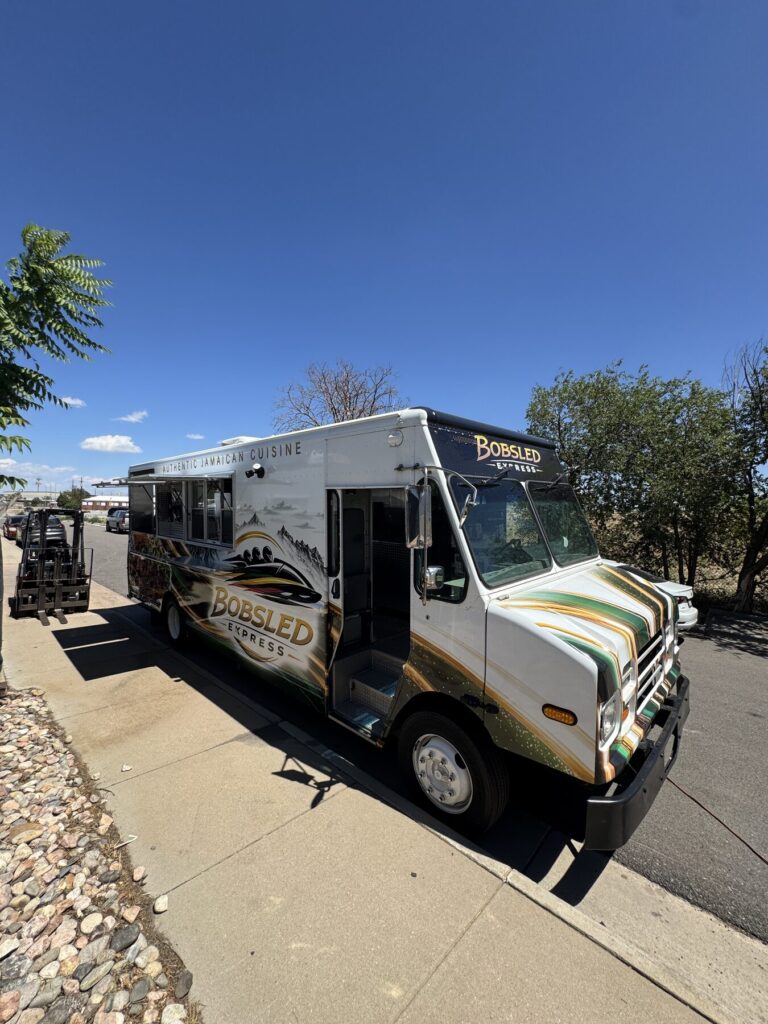
20ft jerk chicken truck with a charcoal porch, Laramie

The back six feet left open so the charcoal smoker never had to come inside the kitchen.

Every one of these started with a phone call and a menu. Call or text 719-722-2537.

On video: trucks we built

Read the video transcript: Fire Suppression / Denver French Truck
Hello and welcome to Zion Foodtrucks. Today we have another exciting project uh leading us. This one is of course going to be here in Denver and it's going to make um gourmet sandwiches. It is 18 ft long and it has a few tricks up its sleeve. Let's look outside and see its uh exterior and then go inside. goes on the outside. What catches your eye would be the the French themed um wrap on the outside. Very beautiful if I may say so. Um very tasteful. Ties all the sandwich theme together. Um that of course is the awning for the 5-ft window. Self-closing obviously as is required by code. The two exterior lights. You can also see the air conditioner on top. The air conditioner also has a heat pump. That is how you would fill water into the fresh water tank. That is how you drain water from the gray water tank. On the back you would see the RV door as we call it. Um basically the code does not allow the the kind of um roll uh the rollup shutter the rollup door that is not up to code which is why we have to do this. I apologize for the road noise. The truck is parked for delivery. So um that is how you would drain the black water tank. This truck has a bathroom inside. So that's how you would train it. Of course that's the shore power connection the generator box of course which is as you can see lockable. It opens up and uh exposes the generator. That obviously is how the that is how the um that's actually where the um propane tank is. We call them underbelly tanks. you don't like them hanging out in the back of the truck. Um, it's a a fire risk in case if it's a rear ended or whatever. Now, let's go inside and see its many features. This truck, as with others that we build, has two doors, one in the back, one in the front. Code requires that any space a human occupies um must have a ingress and an ingress. This is the ingress, of course. Uh, right in front is the refrigerator. And right here is a range. And the range has a griddle and two burners. And the oven, of course, which is why it's a range. Um, the hood, as you can see, slightly oversized. This is because we believe that this customer might add more equipment as they go, you know, as they go about their business. the menu might change. Um maybe they will want soups or something else. Um which is why we left a little bit of space here and a larger hood. Talking about sandwiches, that's what we're going to be making the sandwiches on. This is a sandwich prep table, a refrigerated sandwich prep table. A freezer right there. The freezer is actually resting on a generator box. So you saw that door on the outside. Um, this is the generator box for it. Right there is a little freshwater tank and uh what it is for um is the toilet. This um truck has a restroom inside for the customer's personal use. Not really open to the public, but it is there. Now, you cannot have um obviously the other plumbing is on this side. Um so you cannot have these uh connecting together. What I mean is so the bathroom the water from the bathroom cannot at any point interact with the water um for the you know hand washing or or bear washing which is why it has completely different systems, different setups. So freshwater tank for the bathroom. There's a little water heater behind it. Of course it has its own water pump. And right there is the bathroom toilet, hand wash sink. Of course, hand wash sink also has hot water. This is the the pull tab for the uh fire extinguisher. On this side you would see a larger water heater and this is required because um of the area where this truck is going to be operating in. Food trucks as you know are regulated by um by county code at least for now. The wiring you would see just like with all our trucks um every piece of equipment has its own breaker. They're all home run so to speak. water heater, mop sink, hand wash sink, three compartment sink, and the um the service window. The service window as always is self-closing. So, you lift up, pass your product, and it closes by itself. The controller for the air conditioner, which is right here. lights. Of course, this truck has an all stainless construction and uh inside the walls is 1 in of insulation, 9/16 in of plywood. The floor is aluminum diamond plate and uh addition of the insulation makes it a very comfortable place to work in. If you have any questions or if you would like a food truck like this uh built for yourself, please do contact us through our website zfotrs.com or our phone number 7209-2653. Thank you. Have a nice day.
Walkthrough of the 18ft French sandwich truck with an onboard restroom, Denver.
Read the video transcript: Sodexo Cheyenne
Hello and welcome to Mile High Custom Food Trucks. Today we have a beautiful 16 ft truck that we built for Soro uh that we're just about to ship. Let me show you its uh main features. Come on in. Uh so right in front here is the hand wash and the three compartment. This one's going to Cheyenne County, Wyoming. And they require this uh drain boats on the side for drying the dishes. Of course, uh it comes with the napkin and soap dispenser and the on demand water heater over there, propane water heater. And right at the bottom is the fire extinguisher, ABC fire extinguisher and uh the various plumbing um the water pump and uh little ball valve for draining the water um in case of hard freezes. The hoses that we use are all UL listed so it doesn't chafe or break um due to sunlight or due to washing. All the gas burning in this and all the trucks and trailers that we built are under the floors of the truck. So in case there is a leak at the TE's and unions the gas it spills outside the truck and there is no explosion or or fire inside the truck. Um as the gray water tank it's 42 gallons. This is a three pan steam table and this is a refrigerator. This truck is going to do uh rice bowls, soups, ramen bowls and uh that kind of stuff which is why they need um steam tables. This is a combi oven. Um you can actually cook steak in it if you want to. Uh of course we have done the this requires water and the water plumbing for that is under the under the oven itself. uh it requires LP as well. Again, you can see the LP hoses over there. All pieces of equipment inside this truck and everything else that we build are of course bolted to the floor as well as to the walls. When we bolted to the floor, we use washes so it doesn't shake loose during transport. This is a hot holding cabinet to store burritos and that kind of stuff, breakfast burritos and kind of stuff. This is a self-closing window. This is required by code uh both in this county and elsewhere. Uh the idea is that the awning door that opens and then it's got this plexiglass windows which prop up and then when you're actually taking money or passing the product out, you just lift pass the product and it self closes. Little table over here for the PO station to receive orders. um wiring of course uh all the wiring that we do is inside conduits. This is done so that what happens is that walls of the of a food truck or a trailer, they're not waterproof. They're water resistant so to speak because it's not like wrapped in ty like a house. So water can get in and it can damage wiring. So we put them in these conduits so there is easy access to wiring and they are well protected. Tons of outlets everywhere uh to connect microwaves or P stations or any other piece of equipment that you need. Little sandwich prep over here. This is a 36 in sandwich. This over here is a junction box transfer box actually. So this truck has both generator power as well as shore power. So to switch from utility supply to generator supply, all you needed is to pull this to the side. Um this is the the junction box. Every piece of equipment inside this truck has its own outlets and they're all individually marked. This is done so that in case let's say this tube fails or the the or any other piece of equipment fails, it does not take any other uh any other equipment. Um, this is the generator box with a little remote for the Cumins generator. This has a Cumins 7,000 W uh gasoline generator. Although this is a diesel diesel truck, this is a freezer. Um, you can see it's already at -1 Fahrenheit. 36 in griddle and the two burner stuff. Um, and a chef base. Chef base is a kind of an under counter refrigerator. Um so to to enable really fast cooking. You can store your meats here, pick it up, cross it will cook it up and pass out. That's a 8ft hood with an fire suppression. And uh it has its own speed control. So in the summer you can turn it all the way high and in the winter you can keep it low. So this way you can ventilate this truck quite well. Talking about ventilation, this also has AC with heat. Uh so in case of a hard freeze, you don't have to completely drain all the water in the truck. Um you can just set this to 60 and then the truck will stay warm and that means it will freeze. Uh moving forward uh the Ansel fire suppression of course uh we really like using Anel especially because food trucks sometimes what happens is that they hit a hump and uh the fire suppression automatically deploys. Um never had that problem with Anel. I think that oh uh one last thing this is a TV box. Uh inside this is a TV menu display. It has its own awning and uh that is a HDMI cable over here so you can connect to a laptop and display your menu outside. We'll show you outside when we when we head out. Um, LED lights inside and out. Um, and uh, all stainless construction. The cooking wall is required to be all stainless. Uh, the rest can be a non-porous material. But this particular truck, it's stainless all all around and uh, diamond plate, aluminum diamond plate on the floor. That's about it on the inside and we'll show you on the outside. Uh outside on this uh 16 foot truck that we're shipping out to Cheyenne. On the outside here is the on for the 5T self-closing window. And this is how you fill water. You open this, put in the garden hose, and that fills the fan up. And to drain the water, you just pull a spudger and the water will come down. You can, of course, add a a 3-in hose to take it down to the dump. And this right here is the on for the TV box. The TV display. All the keys in this are matched. Every single key for this and for the generator are the outside here is just the LED outside lights and of course the beautiful wrap that's around it. This truck was built on a a Freight Liner chassis. This is how you fill propane. So, this this truck has a belly tank. So, what you do is you open this thing and it drops here once and then uh you put in your propane line over here. After you're done, it closes back up and uh that's it. On top right there is the 1500 CFM exhaust fan and it also has a little drain pan. So, these run down the side of the truck. This is the generator box housing the 7,000 W commence gasoline generator. inside. This is the the the fuel tank for the the gasoline engine on the generator. That's why because this truck is also the tail pipe. And last, this is the show. There's a man door in the back as well. get in and out of get in and out of this truck. That brings that brings us to the end of of the 16T truck that we live for. So, and thank you.
Walkthrough of the 16ft hospital food truck, Cheyenne.
Walkthrough of the 14ft smashburger truck, Rapid City.
Custom food truck builds delivered to: Colorado · Arizona · Montana · Wyoming
Questions about your build? Call or text, we answer in minutes.Call 719-722-2537Text us