
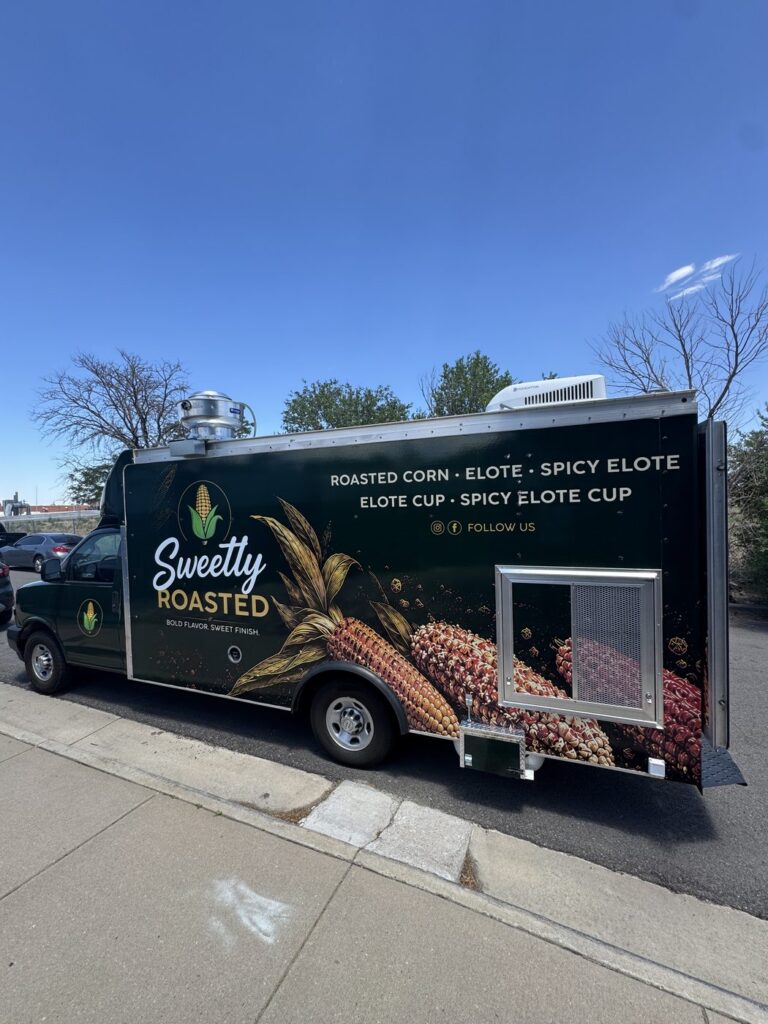
There is a generator box on the side of this truck and there is no generator in it. It holds cups, napkins and boxes of frying oil. That was not a mistake or a cost cut we talked the customer into. Sweetly Roasted looked at where they were going to park, decided they did not need one, and told us to leave it out. We built the box anyway, because the day they change their mind we would rather cut a hole in nothing than cut a hole in a finished truck.
This is a 14ft roasted corn truck on a Chevy box van, built for Sweetly Roasted in Lakewood, Colorado. The menu is roasted corn, elote, spicy elote, and both of those in a cup. It had already shipped and worked a full day of service by the time we filmed the walkthrough, which is why the stainless is not showroom clean in the video. We think a truck that has been used looks better than a truck that has not.

Walkthrough video
Leaving the generator out is a real decision, not a shortcut
Most of the trucks that leave our shop carry a 12kW generator. It is the default because it makes a truck independent. You can pull into a gravel lot at a rodeo, drop the jacks, and cook. Nobody has to find you a plug.
The trade is that you are carrying a small diesel or gas engine everywhere you go. It costs money up front, it burns fuel, it needs oil changes and filters, it is heavy, and it is loud enough that some venues will not have it. Breweries in particular tend to be unenthusiastic about a generator running twenty feet from a patio full of people who came out to talk to each other.
Sweetly Roasted’s plan is brewery lots, private events and city events where power is on site, so they took the other side of the trade. The truck has a proper shore power connection and every appliance sits on its own breaker, with all the wiring run in conduit. If you are going to depend on someone else’s power you want the electrical side of the truck to be beyond argument, because the failure you are trying to avoid is not a blown fuse in your own panel. It is an event organiser looking at your setup and deciding they do not want it plugged into their building.
West Metro Fire Rescue, which covers Lakewood, is direct about this in its mobile food vehicle guidelines. Extension cords cannot be your permanent power source, and you cannot chain power strips together to feed the truck. A truck with individual breakers and conduit passes that conversation in about ten seconds. A truck running on a daisy chain of cords does not.
Where this decision would be wrong is a truck that wants festival work in a field, a park slot with no pedestal, or the kind of roadside spot where the whole point is that you can be anywhere. If Sweetly Roasted goes that direction later, the box is already there and already vented, and fitting a generator becomes an afternoon rather than a rebuild.

What is actually in the truck
A corn concept looks simple from the outside and it is simple, but simple is not the same as small. The cook line has to hold boiled or steamed corn at temperature all afternoon, fry, hold sauces and cheese, and put out a cold product on a hot day. That is four jobs, and they all have to fit in 14 feet with a person able to turn around.
The hot side is a large floor fryer, a two burner stove and soup pots. The fryer is the piece that drove the rest of the build. It is big enough that the fire suppression bottle had to go up a size to cover it, which is the kind of thing that is cheap to solve at the design stage and expensive to solve after the hood is in. Above it all is a Type I hood with fire suppression.
The cold side is a 48 inch refrigerated sandwich prep and a separate ice cream freezer. The prep table is the one piece on this truck that a lot of first time owners under buy. On a corn truck the toppings are the product. Crema, cotija, chilli, lime, butter and mayo all need to be in front of the person building the cup, at temperature, in reach, without anyone opening a door. A 48 inch prep does that. A 27 inch prep means somebody is bending into an undercounter fridge on every third order, and on a busy Saturday that costs you more than the price difference.

Then there are the two pieces that decide how long the day is. A cheese dispenser keeps nacho cheese at a serving temperature and pumps a consistent portion, so the twentieth cup looks like the first one and nobody is standing over a pot with a ladle. And a snow cone machine, which sounds like an afterthought and is not. Corn sells hardest in the middle of the day in summer heat. A shaved ice product gives the same queue a second thing to buy, gives kids something to want, and keeps the window busy through the flat hours between lunch and evening. The fryer and the snow cone machine together are what turn a lunch truck into an all afternoon truck.

Water is a three compartment sink and a hand wash sink with towel and soap dispensers. Colorado’s retail food rules are strict about the grey side of that: under 6 CCR 1010-2 the sewage holding tank on a mobile unit has to be at least 15 percent larger than the fresh water tank, sloped to a drain of an inch or more with a shut off valve. It is a small rule that fails plan review more often than any exotic piece of equipment, usually because somebody matched the tanks.
The service window is a self closing unit with an outside shelf. Outside lighting is colour matched to the wrap, inside lighting is shielded LED, and there is a rooftop air conditioner. Colorado summers are dry but a box with a fryer in it does not care about humidity.

The parts nobody photographs
Three details on this truck are worth more than any single appliance, and none of them will ever show up in a customer’s Instagram post.
The first is the propane. The tanks are mounted underbody, and this truck sits low, so a standard cage was not going to work. We fabricated a custom cage door for it. Under the 2021 International Fire Code, which is the edition the City of Lakewood has adopted, a mobile food preparation vehicle is limited to 200 pounds of LP gas aggregate capacity, and containers have to be securely mounted and restrained. Securely mounted is doing a lot of work in that sentence. An inspector is looking at whether the tank can move, whether the valve is protected, and whether anything can hit it.
The second is the exhaust fan, which has a grease catch pan under it. Every truck with a fryer eventually gets a brown streak running down the side below the fan. On a dark green wrap with corn artwork on it, that streak is the whole brand looking tired. A catch pan is a cheap part that keeps the truck looking new for years.
The third is the trim between the wall panels. Where two stainless or FRP panels meet, there is a seam, and a seam collects grease. You cannot see it, you cannot easily clean it, and after a season the truck starts to smell no matter how well the operator cleans. We trim every panel joint for exactly this reason. It is the single biggest difference between a truck that smells like food and a truck that smells like a truck.

The floor is aluminium diamond plate, which is standard on our builds and is there because a wet floor with corn husks on it is a slip hazard and a mop is not a solution.
Getting a corn truck licensed in Lakewood
Lakewood is one of the more straightforward Front Range cities to launch in, and the reason is that the city has deliberately kept its own layer thin. Almost everything that matters comes from the county and the fire district.
The health licence comes from Jefferson County
The state health department directly licenses only nine Colorado counties and Jefferson is not one of them, so a Lakewood truck is licensed and inspected by Jefferson County Public Health. Plan review comes first. JCPH charges a $100 plan review application fee, then bills the review and pre-opening inspection at an hourly rate capped at $580. You submit drawings, an equipment list, a finish schedule and your tank sizes, and you do not build to a layout that has not been through that process.
The licence itself is where you need to make one phone call rather than trust a web page, including this one. The last fee schedule Jefferson County published, effective January 2025, lists a mobile unit full food service licence at $385 and a prepackaged unit at $270. Since then the state rewrote the statutory fee schedule under Senate Bill 25-285, which sets a full service mobile food establishment at $481 for 2026, rising to $567 in 2027 and $682 from 2028. Other Colorado counties have already moved to the new numbers. Jefferson County’s current fee page is an interactive tool rather than a published document, so budget for the 2026 statutory figure and confirm the exact amount with JCPH on 303-232-6301 before you write the cheque.
Licences expire on 31 December of the year you buy them, regardless of when in the year you bought them. Launching in October means paying twice within three months, so if your opening date is already slipping toward autumn it is usually worth slipping it to January.
You will also need a commissary, and Jefferson County is stricter about this than most. The commissary agreement has to be signed every calendar year, only commissaries located in Jefferson County or the City and County of Denver are approved for mobile units, and the truck is expected to report to it once every 24 hours. The commissary keeps a log of when you came in. Find the commissary before you find the parking spot.
The city layer is smaller than people expect
Lakewood does not issue a food truck permit. The city’s own page says it plainly: there is no food truck permit, you simply have to meet the standards. What you do need is a Lakewood sales and use tax licence, which costs $20, is nonrefundable, and expires after two years. Apply within 30 days of starting or there is a $30 late charge. Lakewood is home rule and collects its own sales tax, so this is not something the state handles for you. If you only work a single event in Lakewood in a calendar year, even that is waived.
There is no separate general business licence in Lakewood. That surprises people coming from other Front Range cities.
On tax, the combined rate you charge in most of Lakewood is 7.5 percent, of which 3 percent is the city. Two districts differ and it is worth knowing which before you set your menu prices: Belmar is 5.5 percent combined, because the city portion there is only 1 percent, and Marston Park and Belleview Shores is 7.93 percent. Call the Revenue Division on 303-987-7630 if you are unsure which side of a line you are parked on.
On zoning, food trucks are allowed in mixed use, commercial and light industrial districts, and are not allowed in residential districts unless it is part of an approved block party. If you are on private property, written authorisation from the property owner has to be on hand at all times, not filed at home. The city also points operators at Municipal Code 8.14 for waste and 10.33.065 for truck parking.
West Metro Fire
West Metro Fire Rescue covers Lakewood and runs an operational permit for mobile food trucks at $50, with requests due at least ten business days ahead. They want the VIN and the plate.
Their guidelines are worth reading before you buy a truck rather than after. The ones that catch people out: a Type I hood with an automatic extinguishing system wherever you produce grease laden vapours, 16 inches of spacing or a non combustible baffle between a fryer and the heat source next to it, a multipurpose ABC extinguisher of at least 10 pounds plus a Class K where there is cooking oil, both tagged annually, ten feet of clearance between fuel in use or storage and anything combustible, and a phone that can reach 911 on the truck or within 25 feet. Exterior generator and LP gas compartments must be enclosed and vented, which is why the empty generator box on this truck is still a proper vented box.
One thing to watch. West Metro serves several jurisdictions and they are not all on the same code edition. Lakewood is on the 2021 International Fire Code, while unincorporated Jefferson County and Wheat Ridge are on the 2024 edition. If you work across those lines, ask which edition applies to the address you are parking at.
What the 2026 reciprocity law changed
House Bill 25-1295 took effect on 1 January 2026 and it matters for a Lakewood truck that wants Denver work. It creates mutual recognition between a Denver issued retail food licence and one issued by a non Denver local health agency such as Jefferson County. In practice a JCPH licensed truck can work in Denver, and a Denver licensed truck can work out here, without buying a second duplicate retail food licence.
Be careful how far you take that. You still have to give the other jurisdiction a copy of your licence at least 14 days before you operate there, and the law does not exempt anyone from local zoning, fire or health inspection. It removes a duplicate licence fee. It does not make one licence a passport. We wrote up the detail of that bill separately, and it is worth reading if Denver events are part of your plan.

Where a corn truck actually earns in Lakewood
Lakewood has about 156,900 people, and 22.6 percent of them are Hispanic or Latino. That is a lot higher than Jefferson County as a whole at 17.2 percent, and lower than Denver at 29.8 percent. Median household income is $89,792, below the county figure of $110,656. Read together, that says Lakewood has a real base audience for the product and a price ceiling closer to Denver street food than to suburban Jeffco.
The venues that work here are not the obvious ones.
Breweries are the weekly bread. Green Mountain Beer Company on South Lewis Way runs trucks essentially every night, and WestFax Brewing on West Colfax publishes a truck schedule that usually runs Tuesday through Sunday. Both take operator enquiries directly. Those slots are how a new truck builds a route without paying event fees.
City events are the spikes. The Sounds Exciting summer concert series runs six shows at the amphitheatre at Heritage Lakewood Belmar Park, from mid June to late July, gates at 5pm with the headliner at 7:15pm, and the city’s own page tells attendees to come and eat from the food trucks. Cider Days at the same site in early October is the other big one, and the city takes vendor applications for it. Note that any food truck at any Lakewood park needs a permit through the community and special event application, and each food vendor at a permitted park event files a $50 nonrefundable vendor permit application with a million dollars of liability insurance naming the city.
The Belmar Fresh Market runs Saturday mornings from June through September at Wadsworth and Alameda, which suits a corn concept better than it suits most trucks.
Two things to cross off the list before you waste a month on them. Red Rocks prohibits private vending outright in its park rules, so no independent truck is working that lot no matter who they know. And Colorado Mills is an enclosed mall with a leased food court, not a truck venue.
Worth knowing about the competition: the elote category in the Denver metro is fragmented. There are established independents such as Moreno’s Corn in southwest Denver, El Elote Feliz on North Pecos, Elotes Asados on Sheridan and Elotes El Burrito on West Evans, and most of them sit along the Federal Boulevard corridor in Denver rather than out here. There is no dominant metro chain. For a truck based in Lakewood that is the opening: the demand exists on the west side, and almost nobody is serving it there.

Why roasted corn is a sensible first truck
We build a lot of first trucks, and most of the ones that struggle struggle for the same reason. The menu is too wide, which makes the cook line too long, which makes the truck too expensive, which means it has to take every booking to break even, which means the owner burns out in year two.
Corn goes the other way. The ingredient list is short and cheap, the prep is quick, the food cost is low, and the ticket time is under a minute once the corn is up to temperature. One or two people can run it and still clear a queue. The failure mode of a corn truck is not complexity, it is running out of corn, and that is a much easier problem to have.
What a build like this costs
Custom food trucks start at $55,000 and custom food trailers start at $40,000. A typical 16ft truck comes in around $72,000 and a 22ft around $110,000. A 14ft corn build with a single fryer, a modest cook line and no generator sits at the lower end of that range, and leaving the generator out is worth real money on a truck this size.
Add the launch costs on top. Plan review and licence through Jefferson County, the $50 West Metro operational permit, the $20 Lakewood tax licence, a commissary agreement, and insurance. Build takes about six weeks from order.
Frequently asked questions
Do I actually need a generator on a food truck in Colorado?
No, but you need to be honest about where you will park. A truck without a generator is cheaper, quieter, lighter and more welcome at breweries and indoor adjacent sites, and it is limited to places with power. If your plan includes festivals in fields, park slots without a pedestal, or roadside work, fit one. We build the generator box either way so the decision stays reversible.
Who licenses a food truck in Lakewood, Colorado?
Jefferson County Public Health issues the retail food establishment licence and does plan review and inspection. The City of Lakewood issues a sales and use tax licence for $20. West Metro Fire Rescue issues a $50 operational permit for the truck. There is no separate Lakewood food truck permit.
Do I need a commissary in Jefferson County?
Yes. Jefferson County Public Health requires a commissary agreement signed each calendar year, and it only approves commissaries located in Jefferson County or the City and County of Denver. The truck is expected to report there once every 24 hours and the commissary keeps a use log.
Can I take a Lakewood licensed truck into Denver?
Since 1 January 2026, yes, without buying a second retail food licence. House Bill 25-1295 created mutual recognition between Denver issued licences and those issued by other Colorado local health agencies. You still have to provide a copy of your licence at least 14 days in advance, and you are still subject to Denver’s zoning, fire and health inspection.
How big do the water tanks need to be?
Colorado’s retail food rules require the waste tank on a mobile unit to be at least 15 percent larger than the fresh water tank, sloped to a drain of at least one inch with a shut off valve. Matching the two tanks is one of the most common reasons a mobile plan review comes back.
How long does a truck like this take to build?
About six weeks from order to delivery once the chassis is in hand. Plan review with the county runs alongside that, and it is the part most likely to add time, so start it early.
More reading
- Food truck inspection requirements in Lakewood, CO
- How to start a food truck in Colorado
- Colorado HB 25-1295 and what the reciprocity law actually does
- Food truck inspection requirements in Denver, CO
Recent Colorado builds
- 16ft catering food truck built for Golden, Colorado
- 14ft Korean food truck built for Castle Rock, Colorado
- School bus to food bus conversion for Grand Junction, Colorado
If you are working out whether a corn truck, a trailer or a van conversion fits what you want to sell, call or text and we will talk through the cook line before anything gets drawn. We have built around 500 food trucks, trailers, bus conversions and van conversions, and we ship anywhere in the country.
Jacob Varghese
Zion Foodtrucks
719-722-2537