

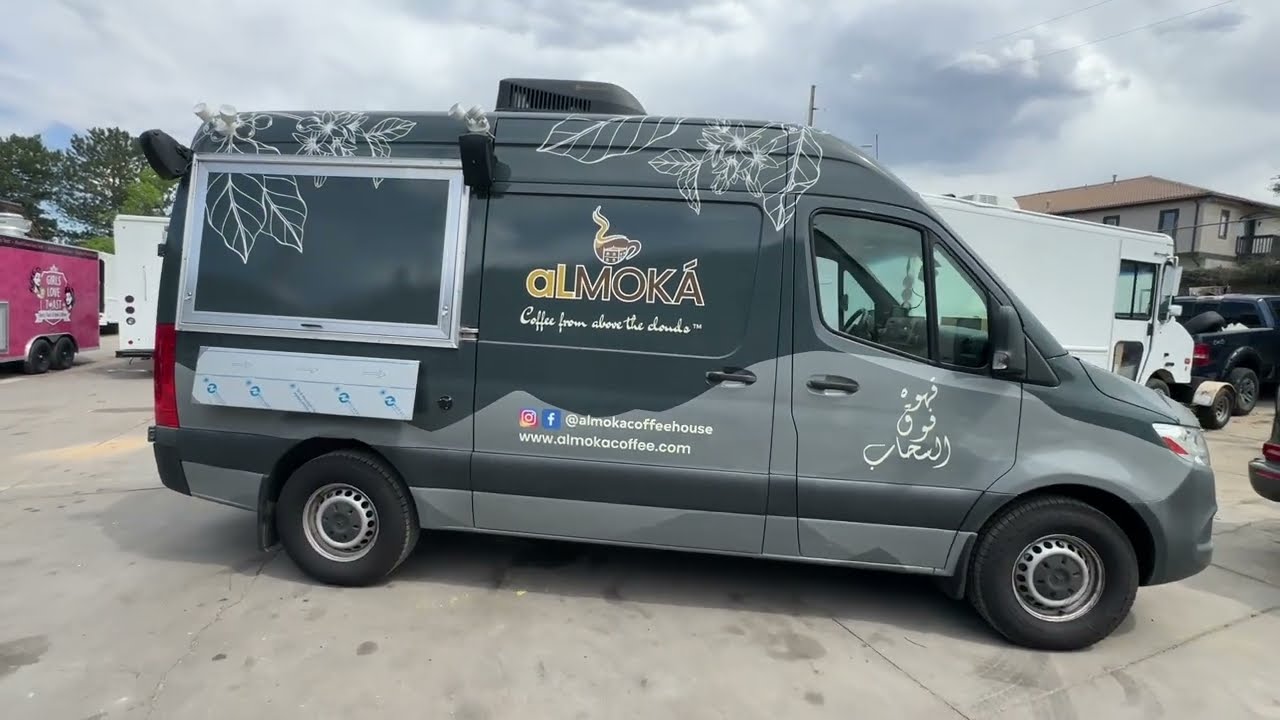
Chicago is one of the hardest cities in the country to run a food truck, and the rules are the reason we started this build with the chassis instead of the menu. A truck in Chicago cannot legally park within 200 feet of a brick-and-mortar restaurant, and it cannot sit in one spot for more than two hours. That combination punishes a big rig and rewards a small, nimble one. So when alMOKA Coffee came to us for a mobile espresso bar to work Chicago and Northern Illinois, we built it on a 10-foot Mercedes Sprinter van, a footprint that slips into a tight Loop curb window, repositions before the two-hour clock runs out, and fits the designated food-truck stands the city sets aside.
alMOKA is a Yemeni specialty coffee brand with a brick-and-mortar cafe in the Rockford area, pouring coffee grown on the terraces above the clouds in Yemen alongside drinks like mufawar and qishr. A van like this lets that cafe reach downtown Chicago office crowds, campus mornings, and private events without opening a second storefront. Here is how we converted it, what the coffee setup demands, and what it takes to put a coffee van on the street legally in Chicago.
Why a Sprinter van, and not a trailer or a box truck
A Mercedes Sprinter is a different animal from a step van or a towable trailer. It drives like a large van, parks in a standard street space, and gives you a tall, insulated cargo area that we can finish out into a clean service space. For a coffee program that lives or dies on being where the customers are at 7 a.m., the ability to move quickly and park legally is worth more than square footage. You do give up interior room compared to an 18-foot truck, but a well-laid-out espresso bar does not need much. It needs the machine, the grinder, water, cold storage, and a clear path for the barista, and that all fits.
Inside, we ran a stainless steel cooking wall behind the service area and food-grade FRP panels on the other walls, over an aluminum diamond plate floor that drains and does not get slick. LED lighting runs through the interior and across the exterior so the service window reads bright and open at an early market or a late event.
The coffee setup, and the power it takes to run it
The bar is built around a commercial espresso machine and a separate hot water boiler, with a full-size standup refrigerator for milk and cold storage and a toaster oven for pastries. That is a deliberately simple, coffee-first layout. There is no fryer and no range, which keeps the build in the lower-risk licensing lane in most cities and keeps the barista focused on drinks.
The thing people underestimate on a coffee build is power. A commercial espresso machine and a water boiler pull hard, especially during a morning rush when both are heating at once. We put a 12kW Cummins generator on this van so the espresso machine, the boiler, the refrigerator, and the lighting all run at the same time without the machine’s recovery time crawling between shots. If you have ever waited on a mobile cart while the group head recovers, you know the difference a properly sized power system makes. This is the single most common place we see cheap coffee builds fall short, and it is worth getting right.
How a coffee van passes inspection in Chicago
Chicago licenses mobile food through the Department of Business Affairs and Consumer Protection, and there are two license classes. A Mobile Food Dispenser license, which fits a truck that pours and serves prepared drinks without cooking, runs 700 dollars for a two-year term. A Mobile Food Preparer license, for on-board food prep, runs 1,000 dollars. A pour-over and espresso program generally lives in the Dispenser class, which is the cheaper of the two, though any real on-board food prep pushes you up to Preparer plus a Food Sanitation Manager certificate. That single choice is the most important licensing decision a coffee operator makes in Chicago.
Two more Chicago rules shape how you operate. The city requires a commissary, so no license is issued without a shared or commercial kitchen agreement, and it requires a working GPS device on the truck under the municipal code. On top of that, if the van runs a fuel-fired generator or carries propane, the Chicago Fire Department wants a fire safety permit, which comes with a blueprint review fee of 150 dollars and a permit fee of 100 dollars, both non-refundable, plus a trained handler on board. Then there is the operating rule that drives the whole design: no vending within 200 feet of a brick-and-mortar food business, and a two-hour cap per location, with designated Mobile Food Vehicle stands like the one near Daley Plaza as the exceptions. We build the van so the mechanical and safety pieces are ready for that joint health and fire inspection, and we walk operators through the licensing lane so the paperwork matches the truck. Confirm current fees and rules with Chicago BACP and the Fire Department before you file. For operators working the Rockford side, Winnebago County licenses mobile food separately, with its own commissary requirement and risk-tier fees.
Water, tanks, and cold-weather coffee
The plumbing is a hand wash sink, a three-compartment sink for wares, and an 8-gallon water heater, fed by a 30-gallon fresh tank and draining to a 40-gallon grey tank, both mounted under the van. Coffee is a water-hungry business between the boiler, rinsing, and cleaning, so those tanks and the water heater are sized to get through a busy morning without a refill.
Chicago winters are the other design factor. Hot coffee is one of the few mobile-food products that actually sells better in the cold, so a coffee van can work year-round while fryer trucks go dormant, but only if the water system is protected. We build for that with insulated, freeze-protected tanks and lines so a January event does not end with a frozen supply line. Chicago sits at low elevation, so unlike our Colorado builds there is no altitude effect on the espresso or the equipment. The enemy here is cold, not thin air.
Why Chicago and Northern Illinois are a strong coffee market
Chicago has a deep, demanding specialty-coffee crowd and a daily rhythm that a mobile bar can plug straight into. The Loop and River North office towers, the medical and university campuses at UIC, the University of Chicago in Hyde Park, and Northwestern in Streeterville all generate morning coffee traffic that a van can meet at the curb. The farmers market calendar adds steady weekend stops: the Daley Plaza market runs Thursdays from late May into October, and Green City Market in Lincoln Park runs deep into November. On the Rockford end, the Rockford City Market runs Friday evenings from mid-May through late August downtown, which is a natural home stand for a Rockford-based brand.
The other half of the opportunity is private events. A mobile espresso bar is one of the most-requested add-ons for weddings, corporate mornings, and conferences, and a Sprinter that can park discreetly and set up fast is exactly the vehicle for that work. For a Yemeni coffee brand with a story to tell, every event is also a chance to introduce drinks most Chicago customers have never had.
Full equipment list
- 10ft Mercedes Sprinter van conversion
- Stainless steel cooking wall, with FRP on the other walls
- Aluminum diamond plate floor
- LED lighting throughout the interior and exterior
- Commercial espresso machine
- Hot water boiler
- Full-size standup refrigerator
- Toaster oven
- 5-foot service window with awning door, self-closing doors, and bug screen
- Hand wash sink and three-compartment sink
- 8-gallon water heater
- 30-gallon fresh water tank and 40-gallon grey water tank, mounted under the van
- 12kW Cummins generator
Walkthrough video
Frequently asked questions
Which Chicago license does a coffee truck need?
A coffee truck that pours and serves prepared drinks without cooking generally needs a Mobile Food Dispenser license, which runs 700 dollars for two years. If you prep food on board, you move up to a Mobile Food Preparer license at 1,000 dollars plus a Food Sanitation Manager certificate.
What is the 200-foot rule in Chicago?
Chicago prohibits a food truck from vending within 200 feet of a brick-and-mortar food establishment, and it limits a truck to two hours in one location. Designated Mobile Food Vehicle stands, like the one near Daley Plaza, are the main exceptions. Those rules are a big reason a compact Sprinter van works well here.
Why does a coffee van need a 12kW generator?
A commercial espresso machine and water boiler draw a lot of power, especially during a morning rush when both are heating. A 12kW generator lets the machine, the boiler, the refrigerator, and the lighting run at once without the espresso machine’s recovery time dragging between drinks.
Can a coffee truck run through a Chicago winter?
Yes, and hot coffee actually sells better in the cold, so a coffee van can work year-round while fryer trucks go dormant. The key is a freeze-protected water system with insulated tanks and lines so nothing freezes at a January event.
Does Chicago require a commissary for a food truck?
Yes. Chicago will not issue a mobile food license without a commissary or shared-kitchen agreement, and the truck must carry a working GPS device. Home kitchens are not allowed.
How long does Zion take to build a coffee van?
A custom conversion like this runs about six weeks in our shop, and we source the vehicle so you do not have to. We build for operators across the Mountain West and the Midwest and ship finished vehicles to their home market.
More resources before you build
- How Much Does a Coffee Truck Cost (2026)
- What Size Generator Do I Need
- Food Truck Electricity and Water Consumption
- What Permits Do I Need (State by State)
- How to Start a Food Truck Business (2026 Guide)
If you are planning a coffee truck, a mobile espresso bar, or a Sprinter conversion of your own, we would be glad to talk it through. We source the vehicle, build it out, and get it road and inspection ready. Reach us at zionfoodtrucks.com or call 719-722-2537.
Jacob Varghese
Zion Foodtrucks
719-722-2537